

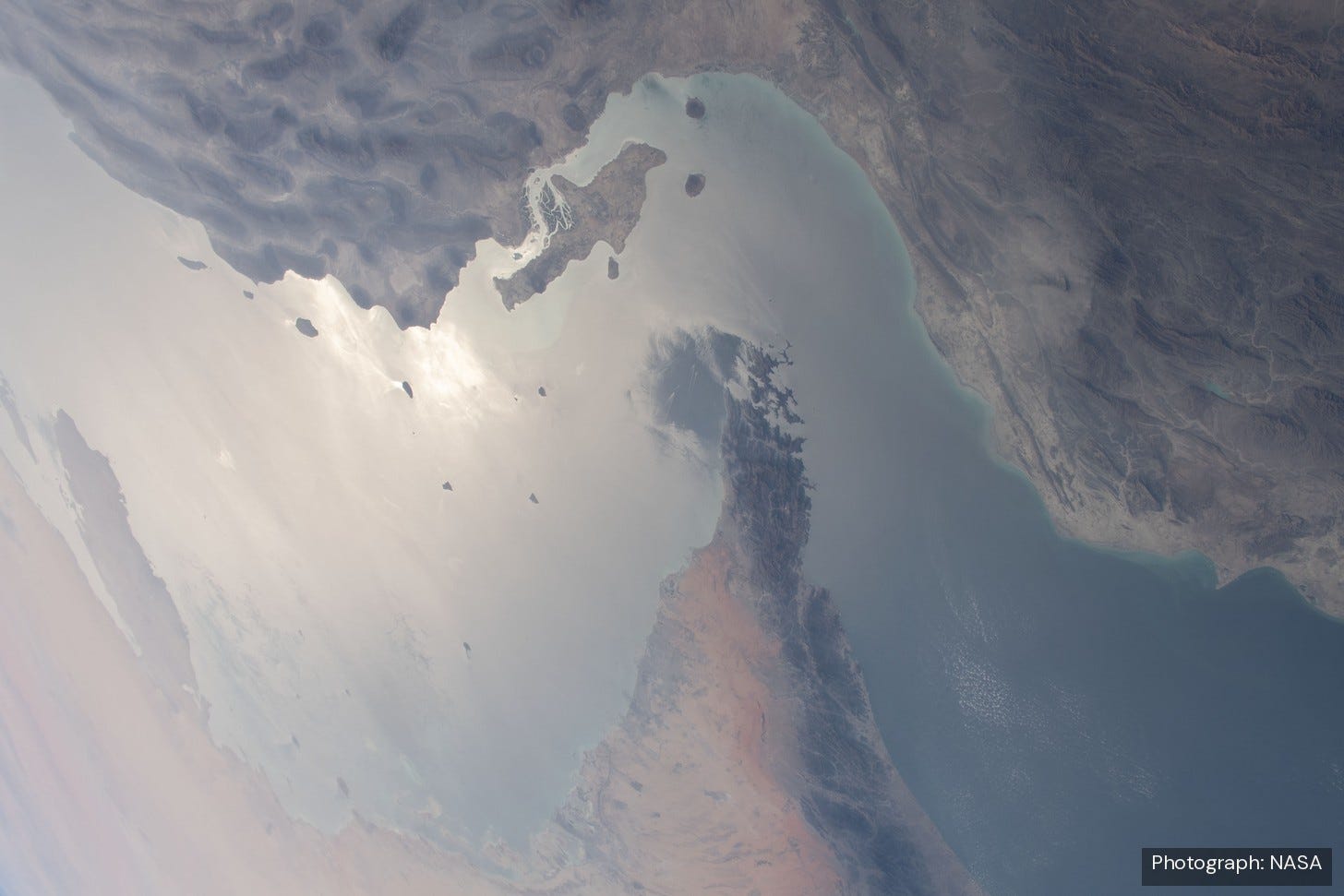
Thirty-five years ago, the UN General Assembly met in the afterglow of an American victory in the Gulf. This week it met in the shadow of an American conflict now in its eighth month, with no end in sight. We spent the week reading the sharpest analysis published since the start of September. Almost all of it comes back to one narrow stretch of water, and to the uncomfortable fact that the states with most to lose from it have the least say over its future.
In September 1991, the diplomats who gathered in New York believed the Middle East was about to be remade. American forces, backed by a broad coalition, had just driven Iraq out of Kuwait. The Madrid peace conference was weeks away, and with the Soviet Union dying, Washington had the region to itself.
This week the Assembly met again in a very different mood. Donald Trump used his speech to threaten to wipe out the Iranian regime. A few hours later, in a room at the UN, Qatari mediators were shuttling between Iranian and American officials. Accounts differ on how much of the three hours the two sides spent face to face. It was their first exchange since June, and by Thursday there was talk of a phased deal.
The Economist, in a long essay from Dubai this week, puts the change bluntly. To the leaders gathered in New York, it argues, America now looks less like the answer to the region’s troubles than one of their causes. The age when a Gulf capital could pick up the phone to Washington whenever something went wrong is closing, and no successor is in view.
A week of messages
The meeting on Tuesday was billed as a summit of Gulf leaders. By the time it convened, Turkey, Jordan, Syria and Iraq had joined, and it had become a gathering of Arab and Muslim leaders. The UAE sent its foreign minister, Sheikh Abdullah bin Zayed, in place of the President. Trump spoke warmly of momentum towards a deal while warning that he might yet bomb an Iranian nuclear site. He announced nothing.
The positions behind the pleasantries remain far apart. Tehran wants Washington to return to the memorandum signed in June. Trump would rather tear it up and start again. The Gulf is quietly on his side. According to The Economist, Crown Prince Mohammed bin Salman has told Americans to keep the blockade in place and hold out for a better deal before going anywhere near the old one, and most Gulf governments agree. Qatar and Oman are the exceptions.
So the Gulf’s leverage is real, and it runs mainly through Washington. Gulf leaders have talked Trump out of a major strike on Iran, and they have urged him not to sign up again to a deal they dislike. What they have not done is win a seat at the table. Anwar Gargash, diplomatic adviser to the UAE President, said as much in New York on 20 September, when he described the influence of Arab and regional states on the conflict as minimal. In 1990, when Iraq invaded Kuwait, the Gulf found a common voice. He thinks it has failed to find one this time, and that it must keep trying.
How the stalemate broke
For much of the summer the conflict held a grim kind of balance. America blockaded Iran’s ports, and Iran kept Hormuz largely closed, but each left the other’s oil and gas alone. Writing on 23 September, Richard Haass and Carolyn Kissane argue that this restraint has now gone. A drone fired by an Iraqi militia struck Saudi Arabia’s East–West pipeline, the line that carries Saudi crude across the desert to the Red Sea, bypassing the strait. It was out of action for more than a week and came back on 22 September.
Yemen moved faster still. Over the summer the Houthis, the Iran-aligned movement that holds most of western Yemen, abandoned the truce that had largely held with their Saudi-backed rivals since 2022. Between 9 and 11 September, they took the port of Mocha and pushed on to Perim Island in the Bab al-Mandab, the narrow gate at the southern end of the Red Sea. Farea al-Muslimi of Chatham House calls it the most consequential territorial change in Yemen in years, and one look at the map explains why. Iran and its allies can now lean on two of the world’s great chokepoints at once. Perim sits about 20 kilometres from Djibouti, where America, China and France all keep bases.
Then the Houthis turned north. Saudi Arabia said it had brought down a drone near Mecca on 15 September. Four days later, a Houthi strike set a fuel depot near Riyadh’s main airport ablaze, an attack on the Saudi capital itself. On Thursday, they fired dozens of missiles and drones at the kingdom. Saudi air defences said they had intercepted six ballistic missiles aimed at Taif and Yanbu, and alerts went out in Mecca and Jeddah. Burcu Ozcelik of RUSI sees a method in this. Tehran escalates steadily but stays just below the point that would bring another heavy American response. She doubts it can keep the Houthis on such a short leash for long.
And yet the price of oil, the lever Iran most wants to pull, has refused to break. Brent climbed to $109 a barrel after the Houthi advance and the pipeline strike, and has hovered between $100 and $110 since. The strain shows instead in oil for immediate delivery, which has sold for more than $130 a barrel this month, and American drivers are paying record prices for diesel with the midterm elections barely six weeks away. Ships are still being hit in the strait. This week the bulk carrier Cape Dao was struck and left ablaze there, and an Indian seafarer was killed. On 23 September Washington imposed sanctions that will, in effect, ground Iran’s airlines abroad.
Inside Iran, the blockade is biting hard. Lorries queue for days at the land borders as trade that once went by sea tries to find another way out. The rial keeps setting record lows, and inflation is approaching three figures. President Pezeshkian has admitted the depth of the crisis. The regime, like Trump, is prepared to take more pain all the same, and neither side can tip the balance. The working assumption in Washington, Tehran and the Gulf capitals is that this runs to the end of the year. One of the largest American banks has said it has given up trying to model the endgame.
Why June failed
The last attempt at an ending is the best guide to the next. Pakistan brokered a memorandum in Islamabad, signed on 17 June, that gave both sides 60 days to negotiate. Trump declared it over on 7 July, and it lapsed on 17 August. Its safe-passage clause never said who would decide which ships could use which routes through the strait.
That silence killed it, according to Mohsen Milani, writing for Chatham House. Tehran read the text as giving Iran and Oman a standing role in running Hormuz. When Oman, with American backing, began steering ships through its own waters without consulting Tehran, Iran went back to attacking them. The deal broke down over who controls the strait, and every proposal since has had to answer it.
What the analysts propose
Some of the people we read would mend June. Others would build something larger, and one sober voice warns that the fighting has further to run.
Nicholas Hopton of RUSI, a former British ambassador to Iran, argued earlier this month that the memorandum should be negotiated properly this time, with sanctions relief as the lever Iran cares about most. Aniseh Bassiri Tabrizi of Chatham House judged that Tehran was waiting for Washington to come back to it. In New York, Iran set out its terms. It proposed a ceasefire across the region for up to 60 days, with Hormuz reopening in stages and the blockade lifted. By Thursday, the two sides were discussing a phased deal in which Iran would reopen the strait as America lifted its blockade. Iran is said to be ready to move its demand for transit fees into a side attachment, which defers the question without giving up its claim to run the strait.
Haass and Kissane would go much further. Their plan asks every party and its proxies to stop attacking energy facilities, and asks Iran to freeze its nuclear work in return for partial relief from sanctions. Its centrepiece is the strait itself. Hormuz would be run by a multilateral authority charging reasonable fees, with every Gulf state at the table, the UAE among them, in place of the regime Iran and Oman are trying to build. They would bring China in, and they concede that parts of the region would have to live with a stronger Iran.
Milani is the gloomiest of them. He thinks neither side is ready to stop, and that both will return to talks only because force can settle neither the nuclear question nor Hormuz. A negotiated end, as he sees it, leaves Iran stronger and pressing to run the strait with Oman and pocket the fees. The idea is five centuries old. Portugal seized Hormuz in 1507 and made every passing ship buy a permit.
The arrangement Haass and Kissane want to head off is already taking shape. In August, Iran and Oman announced a temporary corridor through the strait, running mainly through Iranian waters, and agreed on how to divide its waters and revenues. On 14 September, Tehran said it had finalised a fuller understanding on routes. Gulf foreign ministers had been due to meet Iran that day in Salalah, on Oman’s southern coast, to talk about reopening the strait. Oman postponed the meeting the night before, and Iran said Saudi Arabia had asked for the delay.
The guarantor steps back
Behind all of this sits a larger shift, and The Economist’s essay gives it its sharpest form. America will not leave the Middle East, but it is stepping back from its role as the region’s pre-eminent power. Its allies have lost faith in its judgement, and its voters have lost patience with its wars. It took four years for six in ten Americans to call the invasion of Iraq a mistake. This conflict crossed that line in under two months.
America finished leaving its bases in Syria this spring, and those in Iraq are due to be empty by the end of this month. Gulf governments will not talk openly about the future of the American bases on their soil, many of which Iran has struck, but few expect the naval base in Bahrain, once home to almost 10,000 people, to return to its old size. Qatar is still willing to spend $10bn upgrading al-Udeid, the regional headquarters of American forces. Whether the Americans still want it is unclear. Saudi Arabia closed its airspace to American warplanes in May and so sank an attempt to reopen the strait by force.
Yemen shows what a reluctant guarantor looks like. Trump has turned down repeated requests from the Saudi Crown Prince to strike the Houthis, and his envoys have instead met Houthi representatives in Oman and secured a promise that American ships would be left alone. Milani describes the same drift from a different angle, as the slow wearing away of the order America built in the Gulf after 1991. Ozcelik sees Washington settling into the role of coordinator, supplying intelligence and logistics while others do the fighting.
No outside power is ready to take America’s place. Russia is tied down in Ukraine, and China has no recent experience of fighting far from home. Europe barely registers: when Saudi Arabia asked Britain for help, London offered a single air-to-air refuelling tanker. Within the region, Iran and Israel are strong enough to wreck an order but not to build one, and Turkey is regarded warily by Iran, Israel and many Arab states. The likelier outcome in the short run is a region that splits into blocs, with Arab states attaching themselves to non-Arab patrons. Saudi Arabia’s defence pact with Pakistan and Turkey, signed in Mecca in August, and its new Red Sea maritime alliance of more than a dozen countries point that way. After Thursday’s Houthi barrage, the three pact members called an urgent meeting of their military chiefs.
Where the Gulf states stand
Each Gulf state’s diplomacy follows its exposure to the strait. Qatar has no pipeline around Hormuz, and its LNG leaves Ras Laffan by sea. Kissane estimates that the plant has lost about 17 per cent of its capacity, and Qatar has become the channel through which Washington and Tehran talk. Saudi Arabia has its Red Sea route, which is exactly what the Houthis and the Iraqi militias have gone after. Milani expects Riyadh to seek a managed coexistence with Tehran, because Vision 2030, the Crown Prince’s plan to remake the Saudi economy, depends on calm. He sees Bahrain and Kuwait as most exposed to any future confrontation and most closely tied to Washington and Riyadh, while Qatar and Oman drift toward Iran.
The deeper problem is that the Gulf monarchies’ interests have pulled too far apart for a common line towards either Washington or Tehran. Ozcelik finds the same split in Yemen, where friction between Riyadh and Abu Dhabi has left the Gulf without a settled answer to the Houthi advance. The Economist goes further. Saudi Arabia and the UAE, it notes, cannot work together in Yemen even though the Houthis threaten them both, and neither the Arab League nor the Gulf Cooperation Council has grown into an institution that can carry real weight. Gargash has made the diagnosis. Nobody has yet written the prescription.
The UAE
In a paper published this week, Cinzia Bianco of the European Council on Foreign Relations argues that the UAE became a middle power by making itself almost impossible to bypass, and that its model now depends on what she calls fortified connectivity. The conflict has tested that model hard. By April, more than 3,000 projectiles had been fired at the UAE, and Iran struck Fujairah, the country’s only oil terminal outside the strait, again and again. Nearly 20 ships belonging to ADNOC, the state oil company, have been hit in Hormuz.
The UAE’s answer has been to build around the problem. Output is back to about 3.6 million barrels a day, and the pipeline from Habshan to Fujairah is running flat out at around 1.8 million, with a second line due next year. It is rearming on its own terms too. Earlier this year it signed a ten-year agreement to buy Ukrainian drones, with factories to build them in the Emirates, part of a wider push to make weapons at home.
Its diplomacy has pulled two ways at once. On the night of 18 August, two ballistic missiles fell into the Gulf, and the next morning the UAE cut off all trade and financial dealings with a country to which it had sold some $21 billion of goods in 2024. Less than four weeks later Sheikh Khaled bin Mohamed, the Crown Prince of Abu Dhabi, sat down with President Pezeshkian at the BRICS summit in New Delhi. Gargash calls this deterrence and diplomacy together. He has said that the two countries agreed to turn the page, and that trust could take decades to rebuild. Milani sees Abu Dhabi and Riyadh going separate ways, with the UAE deepening its security ties with America, Israel and perhaps India, and he expects the quarrel with Saudi Arabia to widen.
That leaves the UAE with a particular stake in the endgame. Qatar, Pakistan and Egypt carry the messages between Washington and Tehran, so what matters to Abu Dhabi is who governs Hormuz. A strait run by Iran and Oman, with passage sold by the voyage, would bear hardest on a state whose whole model rests on being hard to route around. Haass and Kissane’s authority would give the UAE a seat. The Iran–Oman understanding would leave it on the quayside. As the American umbrella folds, the question of who sits at that table matters more to the Gulf’s most open economy than to any of its neighbours.
What this means for readers in the Emirates
The planning assumption is a long conflict fought in phases, running at least to the end of the year, with an unstable Iran for some time after it. Anyone running a business or raising a family in the UAE should plan on that basis. With both Hormuz and the Bab al-Mandab under pressure, shipping and insurance costs are unlikely to ease soon, and the International Energy Agency assumes traffic through the strait stays restricted until next year. Most Gulf economies are set to shrink this year, and governments are quietly weighing whether to postpone big events again, from technology conferences to Formula One races.
For Britain, the picture is awkward. Milani expects London and Paris to expand military cooperation and arms sales with the Gulf monarchies as America steps back. When Riyadh actually asked, London offered one tanker. Trade between the UK and the UAE is worth £25.2 billion a year, up 43 per cent on 2016, and the terms on which Hormuz reopens will shape a good share of it. A Britain that wants a voice in the new Gulf will have to decide how much it is prepared to bring.
The Economist ends its essay with guarded hope. The order America built over 35 years kept the oil flowing and the regimes in place, but it never asked the Gulf states to become capable of looking after themselves. Without their old guarantor, they may now have to build something sturdier on their own.
So watch Salalah. If the Gulf–Iran meeting is rescheduled and the UAE is in the room when routes and fees are settled, the minimal influence Gargash described will begin to grow. If Iran and Oman announce their fuller understanding first, the settlement will have been drafted without the state that has worked hardest to be difficult to bypass.
In 1991, America stood at the mouth of the Gulf and promised to keep it open. In 2026, the strait is still 33 kilometres wide at its narrowest, and the question of who holds the gate has passed to the people who live beside it.