

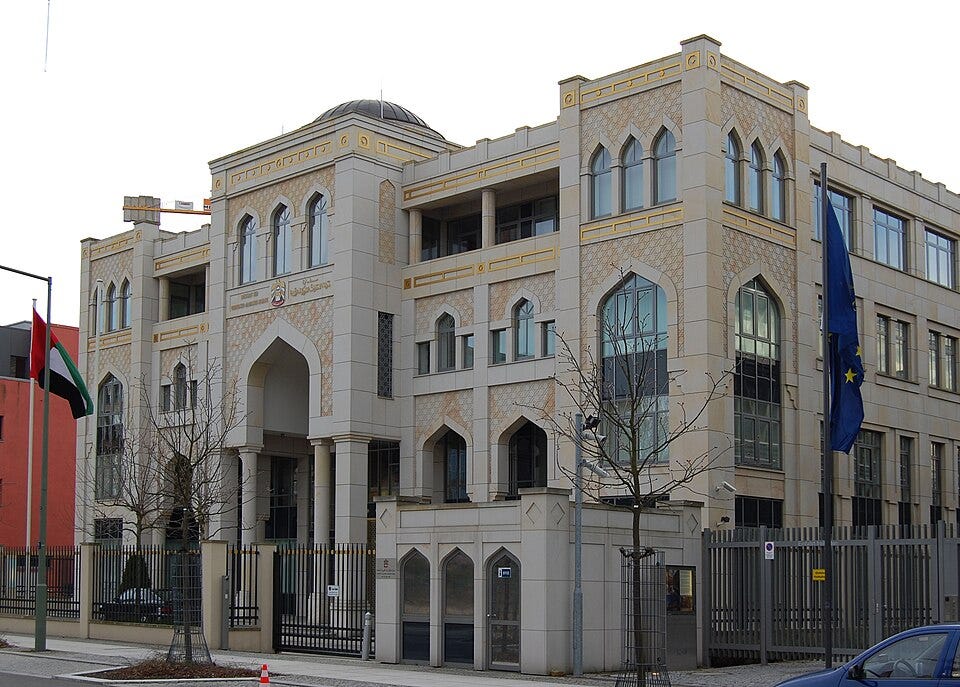
The UAE embassy in Berlin. Photograph: © Achim Raschka / CC BY-SA 4.0, via Wikimedia Commons.
Sheikh Mohamed bin Zayed’s state visit to Germany on 9–11 September produced an announcement of €40 billion in intended Emirati investment, with new data centres among the proposed projects. For Germany, the offer promises investment in businesses and infrastructure; for the UAE, the accompanying agreements offer opportunities to expand its industrial capabilities and commercial reach.
It was the first state visit to Germany by a UAE president, although the countries’ strategic partnership dates from 2004. Treating the visit as a sudden discovery of each other’s usefulness would miss how much was already underway. The interesting question is which new agreements can turn existing relationships into projects neither country would deliver as readily on its own.
What the money means
The €40 billion describes intended long-term investment, in ADNOC’s wording, while the joint declaration includes plans for approximately one gigawatt of data-centre capacity. The announcement does not provide a complete project list or disbursement timetable, so readers cannot yet judge how quickly the money will arrive.
The UAE Foreign Ministry’s declaration dated 11 September separately records 30 business memoranda and agreements worth more than €9.66 billion. That gives the visit a substantial commercial programme, but attaching a value to an agreement tells us little about its readiness. A feasibility study still has to establish whether a project makes commercial sense.
The new German-UAE Investment Council is intended to connect governments and companies, identify viable opportunities and address investment barriers. Its usefulness should show up in decisions that finance projects or remove investment barriers. Another forum earns its place when it helps someone complete work that was otherwise stuck.
Germany, for its part, promised to foster a favourable environment for implementing the investment package. Investors will want to know what that means in practice. The council should provide somewhere to raise difficulties with officials, but its creation does not tell a company how a particular application will be decided or how long it will take.
Gas, with a longer timetable
Abu Dhabi National Oil Company, or ADNOC, and RWE signed a letter of intent to pursue up to two long-term liquefied natural gas supply agreements, with deliveries intended to begin in the early 2030s. That timetable makes this a discussion about Germany’s future supply needs. It cannot offer immediate relief from today’s energy disruption.
ADNOC and its international investment company XRG also signed a memorandum with Germany’s state-owned gas importer, Securing Energy for Europe (SEFE), to explore cooperation across gas supply and associated infrastructure. These arrangements give the parties several ways to deepen their business, provided the commercial terms work.
According to ADNOC, the prospective RWE supplies would serve Germany and other European markets, as well as Asian customers. That detail limits how much of the announcement can be counted as gas earmarked for Germany. The proposed relationship has a wider trading purpose, and the eventual contracts will determine where volumes go and on what terms.
One disagreement is already public. Rainer Seele, XRG’s global chemicals president and Covestro’s supervisory-board chairman, told Handelsblatt that the EU’s methane regulation was cutting Europe off from key supply sources. As a company executive arguing for changes that would benefit suppliers, his objection deserves scrutiny on those terms.
The regulation aims to reduce methane emissions from oil and gas, including by requiring measurement. Buyers’ interest in dependable supplies does not settle how suppliers should demonstrate compliance. Any lasting agreement has to accommodate both.
The industrial return for Abu Dhabi
Covestro provides a more tangible explanation of what the UAE wants from German industry. XRG completed its takeover of the German polymer manufacturer on 10 December 2025, through its subsidiary ADNOC International Germany Holding. The ownership relationship therefore predates last week’s visit.
During the visit, Covestro and TA’ZIZ signed a letter of intent outlining the next steps for a feasibility study of a chemical production chain at Ruwais in Abu Dhabi. The study was first announced in June, so this agreement advances work already underway.
That proposal gives industrial diversification a location and a prospective manufacturing activity. For Abu Dhabi, acquiring a German producer creates an opportunity to develop additional production at home. The study must answer whether Ruwais is the right location and whether the economics justify proceeding.
The partners aim to advance towards a final investment decision, subject to the study and approvals, with production potentially starting in the early 2030s. Owning Covestro gives XRG an established industrial business; building the proposed Ruwais operation would require a further decision and further spending.
The distinction matters when assessing the visit. An acquisition already completed can support new proposals without making those proposals completed investments themselves.
It also changes the question for German industry. Additional production in Abu Dhabi would have to justify itself commercially, while Covestro’s existing operations would need their own investment decisions. Assessing the partnership only by money entering Germany would miss part of its purpose. The Ruwais proposal makes clear that the intended industrial benefits run in both directions.
Wind and computing
Masdar and RWE signed a memorandum to consider joint participation in future German offshore wind auctions, while Masdar and investment firm Luxcara agreed to explore offshore wind and battery-storage projects in Germany and elsewhere in Europe. These are identifiable routes into future projects, each with commercial choices still ahead.
The combination of gas and renewable power makes sense as an investment portfolio across different energy needs. It also cautions against forcing the visit into a single story about either fossil fuels or the energy transition. The companies are pursuing opportunities in both.
The technology announcements are less specific. ADNOC signed collaboration agreements with Bosch Middle East, Siemens Energy and Siemens Industrial to explore advanced technology and artificial intelligence, without naming deployments or delivery dates. There is a plausible industrial purpose here, but insufficient detail to assess what those agreements will produce.
The governments also agreed to explore data hosting through “data embassies”, without setting out their proposed legal arrangements in the joint declaration. Before we can assess that idea properly, we need to know whose data would be hosted and under which country’s protections. The name alone answers neither question.
Berlin’s aviation argument
Aviation offers a clearer example of a concession with immediate political consequences. Germany granted additional traffic rights allowing Emirates to serve Berlin, drawing criticism from Lufthansa. The permission allows up to seven flights a week and excludes onward services from Berlin to third countries.
However, the new arrangement caps Emirates’ frequencies at its four existing German destinations at current levels. Germany has negotiated additional access within defined limits.
Lufthansa said expanding Emirates’ traffic rights would move jobs and economic activity to the Gulf and worsen competitive distortions. Michael Engel, managing director of Germany’s airline association, was blunter, describing the decision as a sell-off of German jobs.
Those objections expose competing interests inside Germany. A government may welcome stronger connections and investment while a domestic airline sees a rival gaining access to its market. A closer bilateral relationship is unlikely to eliminate that disagreement.
The cap on existing frequencies is therefore as important as permission for the additional destination. Emirates gains another place to serve, but the arrangement also limits expansion at the airports it already uses. Calling this an unrestricted opening of Germany’s aviation market would misdescribe the compromise and leave readers unable to judge what each side accepted.
Nor does the timing prove that investment bought the aviation concession. The announcements belong to the same visit; the sources establish no contractual exchange between them.
What happens after the visit
The governments established a Strategic Dialogue to revitalise their 2004 partnership and signed letters of intent covering defence and police cooperation. These give officials a framework for further work, although the declaration does not announce completed defence projects.
Germany also backed a comprehensive, commercially ambitious free-trade agreement between the UAE and the EU, which remains under negotiation. For Abu Dhabi, that support potentially extends the value of the relationship beyond German projects. It is worth following alongside the corporate announcements.
Berlin’s support is politically useful without settling the negotiations. Abu Dhabi can pursue closer access to European markets through a partner with an interest in its success, while still negotiating the terms with the EU. That gives the relationship a purpose beyond the immediate investment programme.
The next assessment should ask which proposals have secured funding and what the companies have agreed to deliver. The gas negotiations deserve their own timetable; the Ruwais study needs its own commercial decision. Treating everything as one €40 billion transaction would obscure the work still required.
For Germany, the gains will depend on where investment arrives and what it sustains. For the UAE, they will depend partly on whether ownership and partnerships help develop businesses beyond its existing strengths. Both questions require evidence from individual projects.
I’ll return to these plans when the partners can say which projects have funding and when construction will begin. Companies with answers are welcome to get in touch; there is room in a future edition for the details.
Emirates Wire is produced by Steve Moore. AI tools help with research aggregation and early drafting. I check every fact against primary sources, and I read and approve every sentence before it goes out. I don't publish anything I haven’t personally stood behind.