

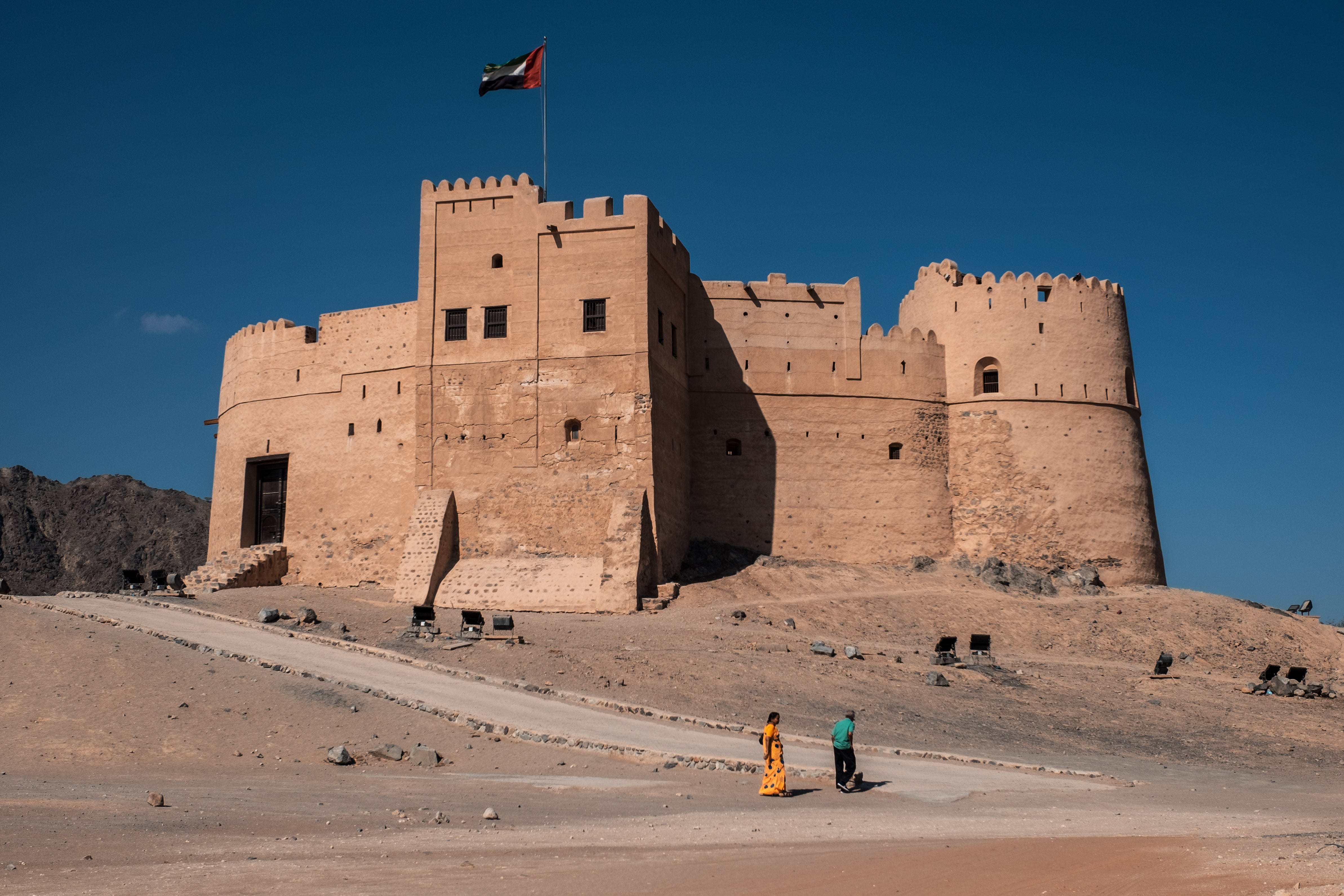
At Fujairah, tankers are loading, and a naval vessel is standing guard. Mohammed Sergie’s report for Semafor, published on Friday, describes a port working hard to accommodate trade displaced by the conflict, with ships transferring cargo offshore and trucks queuing for access.
The previous day, Reuters published its investigation into the attacks that damaged the port earlier this year, including strikes on the systems that move oil from storage terminals to ships. Its account described extensive damage and repair work, while acknowledging that reporters could not visit the sites to fully assess the destruction or every interception.
Fujairah gives us a useful starting point for assessing the UAE’s position after another unsettling week. Keeping a port working after repeated attacks is an achievement. It also forces us to ask how much effort it takes to keep that service running, and what happens if the threat persists.
The country has choices about where to invest and how to protect itself. The difficult question is whether those choices can preserve the openness on which so much of its prosperity depends.
If someone forwarded this edition, subscribe for free to Emirates Wire’s weekday briefings and Saturday longer reads. This weekend, I want to examine what the UAE’s preparedness has delivered and where it may still need to adapt.
What earlier choices bought
Abdulmunim Al Kindy, a board director at Abu Dhabi National Oil Company (ADNOC), offered a concrete account on Thursday. The company prepared for major disruption 10 to 15 years ago, he said, investing in backup facilities and connections that let it switch supply sources and destinations.
Some projects were built “at great expense, even though at the time they didn’t make any commercial sense at the time”, he told reporters. Repeated drills gave employees “almost muscle memory” when disruption arrived.
This is the company’s account, rather than an independent assessment of every facility. It gives us something specific to examine: equipment built before it was needed, and employees who had practised using it.
Energy analyst Robin Mills made a similar argument in The National this week, pointing to the UAE’s ports, shipping and trading capabilities as well as its pipelines. The Habshan–Fujairah pipeline, which provides an export route outside the Strait of Hormuz, opened in 2012. No one needed to predict the precise course of this year’s conflict to see the value of another route.
This region has a longer history of adaptation. Historian Nisha Mathew has traced how connections between Bombay and Dubai merchants shaped Dubai’s development, including a gold trade that exploited restrictions on imports into India. Political upheaval and changing rules redirected commerce; traders and port cities helped find new ways through.
The scale and responsibilities of the modern UAE are different. A country protecting major industrial facilities cannot respond with the freedom of a merchant changing his route. Still, the capacity to reconsider an established arrangement, and act before its replacement becomes urgent, is worth keeping in view.
Adaptability takes investment and practice. Once a crisis arrives, it is much harder to acquire either.
Keeping trade moving
Geography offers alternatives, but it doesn’t make them invulnerable. Reuters’ findings about Fujairah demonstrate that a port outside Hormuz can still be reached by attacks that disrupt the equipment needed to load ships.
Sergie’s account makes the same difficulty visible in the port’s expansion. He describes plans and possibilities for a larger role at Fujairah while noting that its ships, storage and infrastructure remain exposed to regional threats.
There is a reasonable case for further investment. More routes can give operators greater freedom to move cargo when one becomes unavailable. But concentrating additional business at a successful alternative can create another dependency. The question then becomes how to protect and connect that capacity without making too much trade depend on the same facilities.
Economy and Tourism Minister Abdulla bin Touq addressed this balance in an interview with The National on Thursday. Hormuz would remain important, he said, while the UAE had other gateways; he rejected the idea of making the economy safer by “closing and shrinking it”.
That leaves a demanding task for government and business. They need to preserve access while reducing the consequences when access fails. A second route is useful only if cargo can reach it, the necessary equipment works, and someone is willing to carry the goods onward.
For a business, the test extends beyond whether today’s delivery arrives. Can it promise a customer a reliable date next month? Can it commit to a new contract without rewriting the transport arrangements halfway through?
These questions do not establish that companies are leaving or that the UAE is running out of options. They explain why sustained uncertainty deserves attention even when essential operations continue. Successful improvisation can become expensive if it has to be repeated indefinitely.
There is also an opportunity. New routes and relationships developed under pressure may remain useful afterwards. The UAE could emerge with a wider range of options, but that outcome depends on whether the new capacity is secure and commercially useful.
It would be a mistake to assume the strongest response is always to recreate every interrupted service somewhere else. Some alternatives may be too costly or too dependent on the same exposed connections. Others could make ordinary trade easier long after the immediate emergency. Choosing between them requires a view of the economy the UAE wants to develop, as well as the disruption it needs to manage.
Saudi security and Emirati choices
The attacks on Riyadh’s airport show how quickly the consequences can extend beyond the site of an explosion. Allison Minor, a former US deputy special envoy for Yemen, argues that disruption to the airport threatens the flow of investors, executives and political visitors on which Saudi Arabia’s ambitions depend.
The UAE has expressed full solidarity with Saudi Arabia and support for measures to protect the kingdom’s security and stability. That official statement is important, but it does not announce an Emirati role in a particular offensive operation.
Closer co-operation makes sense if it improves warning systems or protects shared routes. Its usefulness would depend on what the two countries can do together and how clearly they agree on the limits of their commitments.
Yemen makes that harder. In her analysis for the Center for Strategic and International Studies, Minor argues that Saudi–UAE differences amplify divisions among the Yemeni forces opposing the Houthis. She warns that another campaign relying on airstrikes and fragmented ground forces, without a credible political objective, could prolong a conflict that the Houthis have repeatedly survived.
A shared danger can make co-operation urgent, but it does not settle disagreements about what should follow a military campaign. Abu Dhabi’s question is how to support Saudi security while helping establish an outcome that would make repeated intervention less necessary.
Any wider Gulf arrangement would face a similar test. Shared concern needs to produce agreed responsibilities and working arrangements. Announcing a common purpose has little value if governments disagree about the actions it requires.
What Washington might change
American involvement is already part of the picture. The Associated Press has reported on US naval protection for shipping, the blockade of Iran, and ongoing diplomatic exchanges.
The uncertainty concerns what Washington might do next. On Friday, Reuters reported that Donald Trump had said in a Thursday-night interview that the US might strike Pickaxe Mountain, a site associated with Iran’s nuclear programme. That report did not establish that a new strike had been authorised.
Additional defensive assistance, attacks on the Houthis, and renewed strikes inside Iran would give the UAE different options. More protection could help keep trade moving. An expanded offensive would require a separate assessment of its objectives, likely effectiveness and the risk of retaliation against Gulf states.
The distinction matters when discussing American reassurance. A larger military commitment might strengthen protection while also changing the threats that protection needs to address. Gulf governments would have to assess both effects, rather than treating more force as a guarantee of greater safety.
Diplomacy remains part of the UAE’s stated approach. Dr Ali Rashid Al Nuaimi, chairman of the Federal National Council’s Defence, Interior and Foreign Affairs Committee, told journalists on Thursday that the country was better prepared for renewed conflict. He also said dialogue remained a priority, despite profound distrust of Iran.
There are reasons to take that distrust seriously. Ali Alfoneh’s review for the Arab Gulf States Institute describes Iranian strategists calling for attacks on UAE infrastructure and portraying its commercial position as a threat to Iran. Those remarks are evidence of a hostile argument within Iran, not an announced government decision to launch another attack.
The practical question is what an agreement would need to cover. Protection for civilian infrastructure and dependable commercial passage would have to survive disputes elsewhere. Promises would need mechanisms to check compliance and respond to breaches.
Keeping a channel open does not require assuming those conditions can be secured easily. It preserves the possibility of reducing dangers that defensive spending alone cannot remove.
Preserving room to move
The UAE’s strongest argument for confidence lies in the choices it can still make. As Al Kindy and Mills describe, its preparations have given operators alternatives when established arrangements fail.
The lesson to draw is to keep creating those choices. That might mean another route, better connections between existing facilities, or a diplomatic arrangement that lowers the risk of using them. Some investments will appear underused in calmer times. We need to judge their value against the disruption they could prevent.
We should also be precise about what improvement would look like. Facilities would remain available for longer without interruption. Businesses could make commitments with fewer contingencies. Regional governments would have clearer responsibilities for protecting shared interests, and negotiations would produce terms whose implementation could be checked.
None of that requires the UAE to wait for the entire Middle East to become predictable. It does require an honest assessment of whether each adjustment makes the country safer or simply moves the exposure elsewhere.
The next phase will test whether the country can keep adapting without allowing emergency arrangements to consume an ever larger share of ordinary life. A working port is a considerable achievement. The longer ambition is for people relying on it to be able to plan and expect to keep their plans.
Thank you for reading. Please share this edition with someone weighing up what continued regional insecurity means for their work or family.
If you run a business in the UAE, I would particularly welcome an account of an adjustment that has worked, or a disruption that remains difficult to manage. Reply, leave a comment or write to steve@emirateswire.co.uk.
Steve
How this piece was made
Emirates Wire uses AI tools to assist with research, early drafting, fact-checking and copy-editing. Steve Moore reviews, edits and personally approves every sentence before publication.
Reading and acknowledgements
This essay draws on Reuters’ infrastructure investigation, Mohammed Sergie’s reporting from Fujairah, Robin Mills on resilience, and Allison Minor on Yemen. Nisha Mathew’s research on Bombay, Dubai and Indian Ocean commerce informs the brief historical passage.