

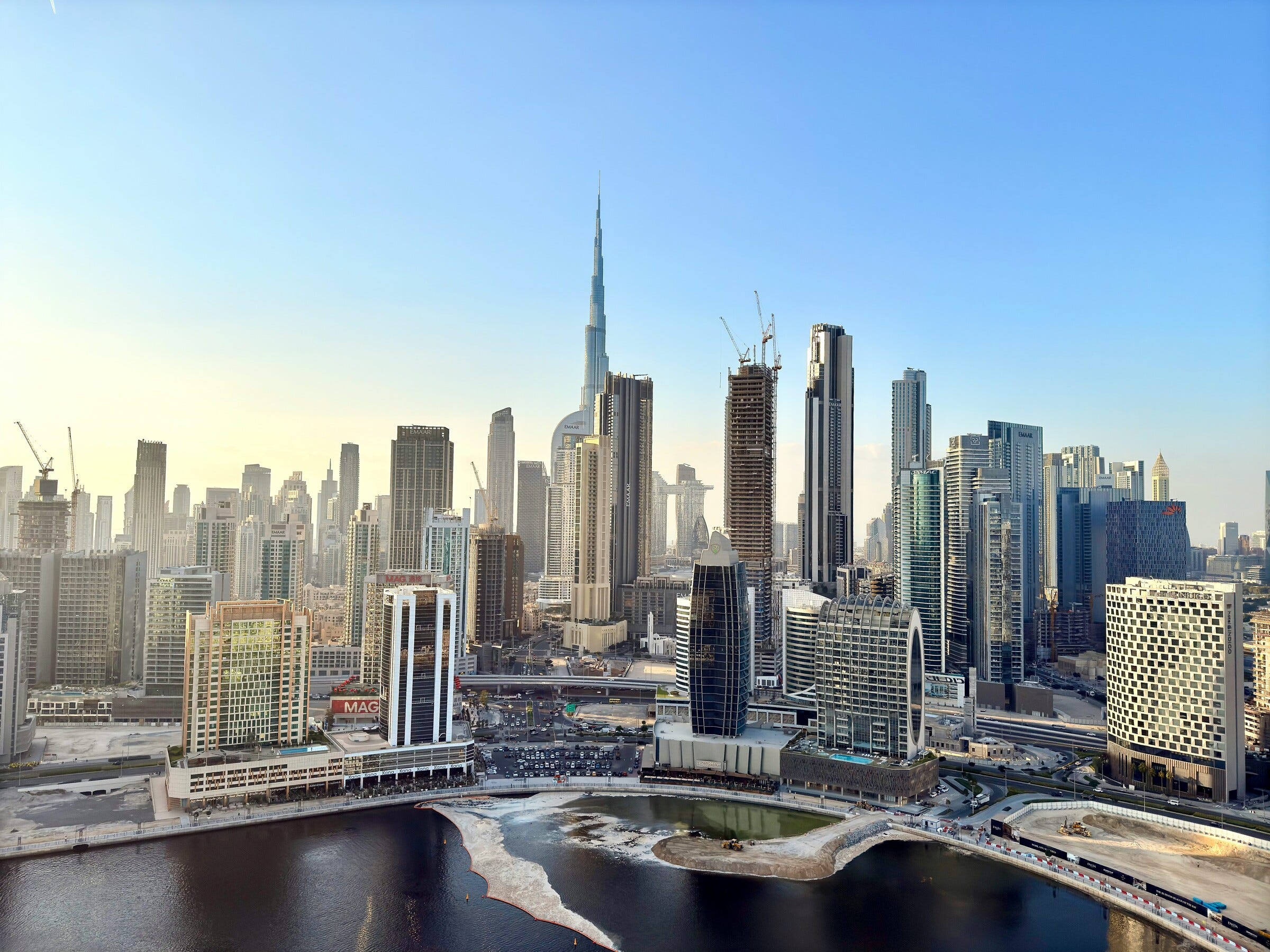
Credit: Sirav Talwar / Unsplash.
Morning. Steve Moore here. The International Monetary Fund (IMF) expects the UAE economy to shrink by 3.9% this year, before growing by 7.7% in 2027, according to its October World Economic Outlook, reported by The National and Khaleej Times. On Tuesday, Sheikh Mohammed bin Rashid set out Dubai’s project plans, saying the emirate’s development was accelerating.
The forecast and the project plans cover different things: economic output over a year, and investment commitments extending well beyond it. The IMF’s expected recovery also depends on shipping routes returning to normal, with its scenario assuming a gradual reopening of Hormuz from March next year.
If someone forwarded this edition, subscribe to Emirates Wire for free each weekday morning. I follow the decisions and developments affecting people living and working in the UAE.
IMF cuts its UAE forecast by seven percentage points
The fund had expected 3.1% growth in April; its new forecast is a 3.9% contraction for 2026. That is a seven-percentage-point downgrade, followed by a projected 7.7% rebound next year.
The National reports that the IMF assumes Hormuz begins reopening gradually in March 2027, with pre-conflict conditions returning by October. The fund expects uncertainty to remain elevated throughout next year.
Those dates are modelling assumptions, not an agreed reopening timetable. A longer disruption would call the recovery forecast into question.
The outlook also puts UAE inflation at 4.5% this year, compared with 1.3% in 2025, Aletihad reports. For households, that forecast means rising prices alongside weaker economic activity.
Dubai sets out Dh2.1tn in projects
Dubai’s announcement spans a much longer period. Figures presented at the Mohammed bin Rashid Leadership Forum put the value of projects under way at Dh2.1tn (about £432bn).
“Our journey is accelerating, not slowing down,” Sheikh Mohammed wrote on X. The figures include Dh1.1tn (about £226bn) in real estate projects through 2030, Dh128bn (about £26.3bn) for Al Maktoum International Airport and Dh328bn (about £67.4bn) for Emirates and flydubai fleet expansion, Gulf News reported, citing Dubai Media Office.
These are project values and commitments across several years; the announcement does not establish how much has already been spent. Their contribution to output depends on when work is carried out.
At the same forum, Roads and Transport Authority (RTA) director general Mattar Al Tayer said a team was examining an integrated underground transport network. The report said the proposal is under study, with no completion date set.
UAE backs Saudi security measures
The UAE also pledged support for Saudi Arabia in a call between their foreign ministers, the Emirates News Agency and WAM reported on Tuesday. Sheikh Abdullah bin Zayed told Prince Faisal bin Farhan: “The UAE will support all measures that Saudi Arabia takes to safeguard its security and stability.”
The Wall Street Journal’s editorial board is urging US help for Saudi Arabia and has floated an anti-Houthi alliance involving Israel and the UAE. That is the newspaper’s proposal; it should be read separately from the UAE’s statement of support.
Earlier, Houthi-run Al Masirah television said overnight Saudi airstrikes had hit Kamaran island, Qanawis district near Hodeidah and Jawf province in Yemen. Saudi Arabia had not immediately commented in the Associated Press (AP) report, so the attribution of those strikes remains the Houthis’ account.
The Houthi-controlled foreign ministry also warned airlines that flights to Saudi airports were “unsafe”, except those serving the holy sites of Mecca and Medina. That is a statement from a party to the conflict, not an aviation safety clearance for the exempted flights.
Saudi airspace risks reach beyond cancelled flights
The airport attacks also raise questions about routes serving the UAE. In The Economist’s Middle East Dispatch, correspondent Gregg Carlstrom, writing from Riyadh, explains that Saudi airspace has provided a westbound corridor for Gulf flights avoiding Iran and Iraq.
The European Union Aviation Safety Agency (EASA) recommends avoiding specified parts of Saudi airspace at every altitude and exercising caution elsewhere in the Jeddah flight information region. Its bulletin warns that missile and drone attacks, air-defence activity and falling debris put civilian aircraft at risk. Carlstrom’s concern is that further restrictions could also disrupt flights to Dubai and journeys between Europe and Asia.
Etihad’s live notice, checked on Tuesday, says it has cancelled all Abu Dhabi–Riyadh and Abu Dhabi–Dammam flights through Sunday 18 October. Its Jeddah services EY601 and EY602 are cancelled through the same date, while EY603 and EY604 are cancelled until Monday 19 October.
flydubai told ARN News that cancellations to Saudi destinations, including Riyadh, Dammam, and Abha, run up to and including 19 October. Because the dates and wording differ, you must check your individual booking.
Gulf Business reports that the aviation notice for Riyadh’s King Khalid International Airport lists a closure until 21.00 GMT on Saturday 17 October, midnight at the start of Sunday in Saudi Arabia. That is the published closure deadline, not a confirmed reopening or a promise that cancelled flights will resume.
Iranian panellists discuss attacks on UAE targets
Separately, the Arab Gulf States Institute has published a report on Iranian commentators advocating attacks on UAE infrastructure. Ali Alfoneh’s Iran Media Review, published on Tuesday, covers a panel recorded on 4 October and released on 8 October.
According to Alfoneh, strategist Ali Samadzadeh called for attacks on Fujairah port and the Habshan–Fujairah oil pipeline. Majid Shakeri, whom the institute identifies as an adviser to Iran’s parliamentary speaker, said: “If flights do not take off from our airports, flights won’t take off from the region’s airports either ... The region’s airport is Dubai.”
The institute reported and translated these remarks. They do not establish an announced Iranian government decision or an imminent attack on Dubai.
Shipping transfers come under threat
At sea, the Institute for the Study of War says Iran appears to be targeting vessels conducting ship-to-ship oil transfers in and near Hormuz, AP reports. These operations move cargo between vessels offshore, helping oil continue its journey beyond the strait.
The United Kingdom Maritime Trade Operations agency reported that at least three vessels were hit by unidentified projectiles on Sunday. AP said no one immediately claimed responsibility; the think tank’s assessment does not independently identify the attacker in each incident.
Brent closed at $106.65 a barrel on Monday. Diplomatic exchanges continued on Tuesday, when Iran’s Deputy Foreign Minister Kazem Gharibabadi said Tehran was finalising its response to US comments on the proposal it submitted in New York, Iran International reported.
Mubadala separates UK investment from City’s ruling
After Saturday’s review of Abu Dhabi’s options over Manchester City, a senior Mubadala executive addressed UK investment. Waleed Al Muhairi, the investment company’s group deputy chief executive, was asked at the Bloomberg New Economy Forum in New Delhi whether the ruling would affect its investments in Britain.
“I think that’s its own separate process,” he said, according to Bloomberg. He said Mubadala continued to invest in the UK, judging opportunities by partnerships, risk and reward, and what made sense over time.
His answer addresses Mubadala’s investment decisions. It leaves City’s legal options, and the decisions of other UAE investors open.
Global Village opens today
For an evening closer to home, the attraction’s 31st season begins at 4 pm, with gates open until midnight on Wednesdays. The season continues until May 2027.
Four RTA bus routes serve the attraction: 102 from Centrepoint Metro; 103 from Union; 104 from Al Ghubaiba; and 106 from Mall of the Emirates. According to the RTA, Route 103 runs every 40 minutes, while the other three run hourly.
The authority is also bringing back two electric abras for trips on the waterways inside Global Village. Check the attraction’s opening information and your bus journey before setting out.
What to watch today
Saudi Arabia: Any Saudi confirmation of the reported Yemen strikes and further details of the UAE’s support.
Travel: Airline schedule changes and updates to Riyadh airport’s closure notice.
Hormuz: Iran’s formal response to Washington and further reports involving offshore oil transfers.
Dubai: Global Village’s opening evening and the resumed bus services.
Thank you for reading. Please share this edition with someone weighing up what the economic forecasts, project announcements or travel changes mean for them.
I welcome your questions, corrections and first-hand accounts. Reply to this email, leave a comment or write to steve@emirateswire.co.uk.
If you’re taking one of the buses to Global Village, let me know how the journey works in practice. I’d welcome a reader’s view from the opening evening.
Steve
Emirates Wire uses AI tools to assist with research, early drafting, fact-checking and copy-editing. Steve Moore reviews, edits and personally approves every sentence before publication.