

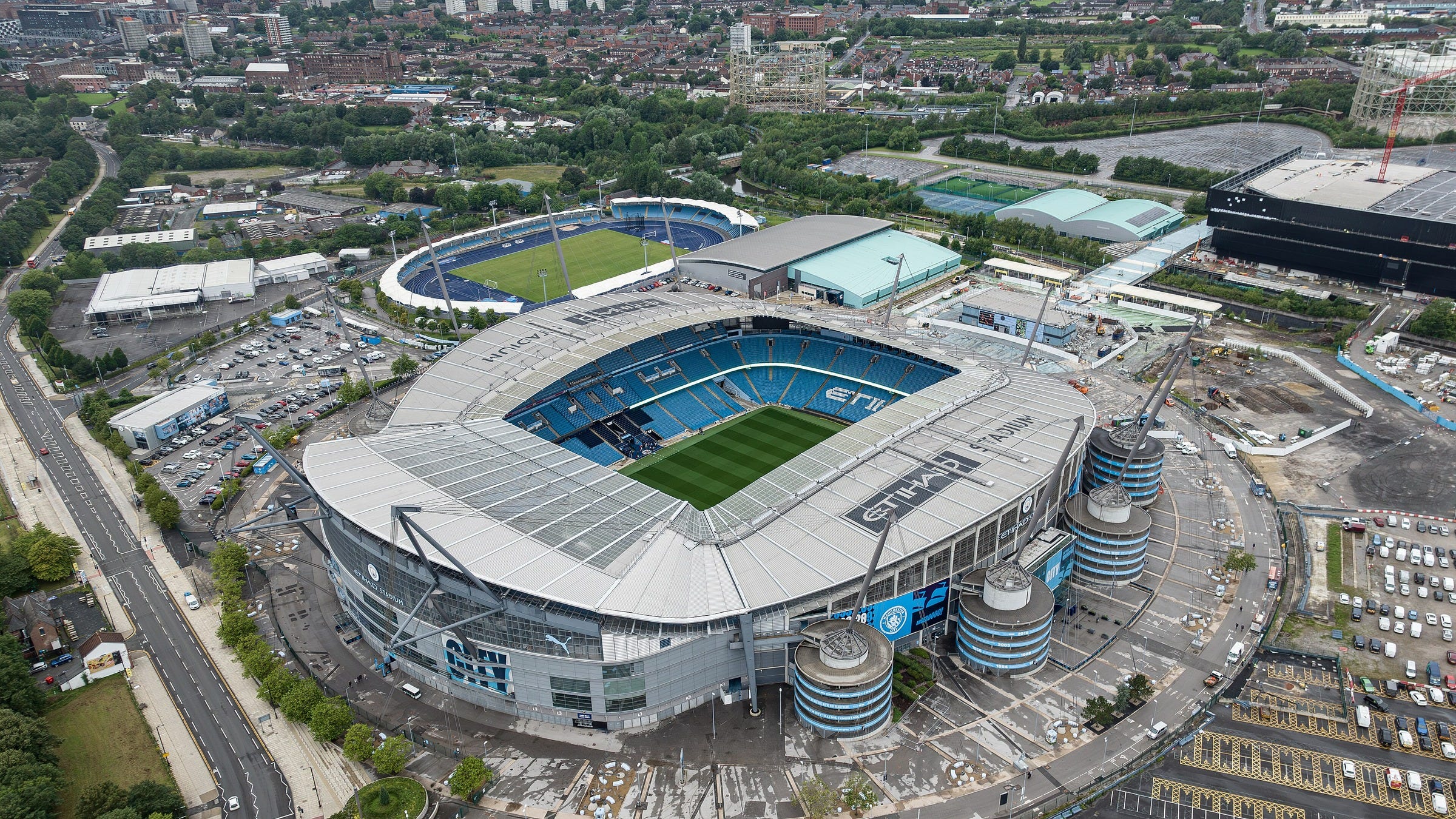
Photo: Arne Müseler / www.arne-mueseler.com, Wikimedia Commons, CC BY-SA 3.0 DE. Cropped and resized; this version is shared under the same licence.
Written and edited by Steve Moore
Manchester City announced on Friday that it had appealed against an independent commission’s ruling that the club repeatedly broke football’s financial rules. The club maintains its innocence and says the decision contains fundamental errors; it lodged the appeal on Thursday evening, before Friday’s deadline.
Bloomberg reports that Emirati officials have privately warned Britain that the ruling’s severity could weaken their appetite for future investment. Citing unnamed people familiar with the discussions, it also reports frustration among British officials with their Emirati counterparts.
Neither government publicly confirmed those exchanges to Bloomberg: a British spokesman declined to comment, and the UAE’s Foreign Ministry did not respond. The report comes as officials prepare for investment talks in London this month.
What the commission decided
The Premier League investigated and brought the case; an independent commission heard it and published its findings on Tuesday. The League began investigating in December 2018, brought proceedings in February 2023 and presented its case at a 42-day hearing which ended in December 2024.
The case comprised “well over 100 individual breaches”, grouped into broader charges and sub-charges. The commission found all the financial-rule charges proved, alongside three of four categories of alleged failures to co-operate; the remaining co-operation sub-charge, 4(B), was not proved.
At the centre of the case is how City recorded money coming into the club. The commission found that some commercial agreements presented as sponsorship income were substantially funded by Abu Dhabi United Group, the owner’s investment company, rather than by the sponsors themselves.
The commission concluded that City should have recorded this money as contributions from the owner, rather than commercial income. It found that correcting the accounts would show City had exceeded the relevant spending limits by a substantial amount.
According to the League’s summary, the accounts made City appear to earn more and incur fewer costs, by more than £900 million across the affected period, 2009/10 to 2017/18. The commission called several arrangements “shams” and concluded that the club had concealed its true finances from auditors and football regulators, then frustrated the League’s investigation.
These are findings in a football disciplinary case, subject to appeal. They are not a criminal conviction, and the commission has yet to determine the sanction in a separate hearing.
City’s response and the separate regulator
City alleges “clear material errors of law, principle and fact” in the decision. Its statement maintains that the club is innocent and that a comprehensive body of evidence supports its position.
An appeal board can uphold, dismiss or vary a commission’s decision under the League’s rules. Those rules also give the commission broad discretion over sanctions, including fines and points deductions, but no particular punishment has yet been announced in this case.
The chair of the League’s independent judicial panel appoints the three members of an appeal board, one of whom should have held judicial office and would chair it. The city’s public statement sets out its objections in broad terms, without publishing the detailed arguments the board will consider.
An appeal does not itself erase the findings, lawyer Lois Langton told ESPN; her colleague Kyle Phillips said the sanctions process could continue while an appeal was pending. Phillips also distinguished expulsion from relegation: the Premier League could expel City, but could not itself allocate the club a place in the separately administered English Football League.
The League has so far released a redacted core decision, with supporting appendices still unpublished. It says it will publish them when permitted under the confidentiality rules governing the proceedings.
Separately, the Independent Football Regulator can assess the suitability of club owners, directors and executives. Its chairman, David Kogan, said on Wednesday that the decision raised “serious issues”, but that the regulator would await further developments in the proceedings.
The regulator’s ownership powers do not make it the appeal body for this case. Nor has it announced a decision to remove an owner or require a sale.
Who owns City?
Sheikh Mansour bin Zayed Al Nahyan is City’s ultimate owner, a UAE vice-president and deputy prime minister, and a brother of President Sheikh Mohamed bin Zayed. He owns Newton Investment and Development LLC, the majority shareholder in City Football Group, which also has outside investors including Silver Lake.
Abu Dhabi United Group, usually shortened to ADUG, acquired City in 2008 and subsequently entered the Manchester Life property partnership. The commission also identified it as the source of the disguised sponsorship funding during the period under investigation.
City’s chairman, Khaldoon Al Mubarak, also leads Mubadala, Abu Dhabi’s sovereign investor and a partner in Britain’s investment programme with the UAE. His roles connect the club to the wider investment relationship, although the club, its shareholders and the governments remain distinct actors.
Under Sheikh Mansour’s ownership, City have won eight Premier League titles and recruited players including Sergio Agüero, Kevin De Bruyne and Erling Haaland. Bloomberg describes the club as one of the UAE’s most successful means of projecting soft power: gaining international recognition and influence through sport.
The relationship Manchester built
The investment extended beyond the team and its stadium. In 2014, Manchester City Council announced a property partnership with Sheikh Mansour’s interests to develop housing in Ancoats and New Islington, under the Manchester Life name.
By the time Sheffield researchers examined it in 2022, the partnership had delivered 1,468 homes, most for private rent and the remainder for sale. Their report identified no affordable housing within those developments.
The council’s account is that Abu Dhabi’s investment made development possible at a scale and speed the market would otherwise have struggled to provide. In its response to the research, it pointed to independently valued land, new homes and businesses, additional council tax and business rates, and investment which encouraged other developers to follow.
Burnham later described the owners as partners in building modern Manchester. He was Greater Manchester’s mayor from 2017 until June this year; both the takeover and the establishment of Manchester Life preceded his mayoralty.
What the Sheffield research questioned
Manchester Offshored, published in July 2022 by Richard Goulding, Adam Leaver and Jonathan Silver, examined who owned the partnership’s assets, who received its income and what the council obtained in return. Its authors used company accounts, planning records and other public documents, and sought clarification from the council and Manchester Life.
They argued the council had agreed unfavourable terms, including long land leases and arrangements that placed property assets and income rights in Abu Dhabi-owned structures, often through Jersey. They also questioned whether the public could adequately scrutinise the partnership when important financial terms remained confidential.
The leases ran for 999 years, and the researchers argued that prices fell below those in comparable deals. The council disputed the comparison: it said land had been independently valued when market interest was low, and that subsequent development had made the area more attractive to investors.
The authors acknowledged the council’s claim to additional payments under “overage” arrangements, through which a land seller can share in subsequent value. But they could not establish the terms or identify receipts in the available accounts.
The researchers accepted that a council with limited tax-raising powers and investors seeking returns could both benefit from a development partnership. Their objection concerned how the benefits were shared in this deal.
The council rejected the suggestion that the deals had been poor value. It said in 2022 that profit-sharing arrangements existed and that a first payment of several million pounds was due that financial year.
Its response this week goes further, saying it is receiving a significant financial return and that higher land values reflect Manchester Life’s investment. The Guardian also reports that a council review published in July identified both significant benefits from development agreements and weaknesses in documentation, monitoring and assurance, particularly around profit-sharing.
The researchers and council thus disagree over the public return from the partnership. That dispute concerns property development and accountability to Manchester’s residents, separate from the commission’s findings about football finance.
Why Burnham’s comments matter
Speaking to the BBC on Wednesday, Burnham said he would be “really concerned” to lose City’s owners and thanked them for investing in the city as well as the football club. He also said it would be wrong for him to intervene in the proceedings.
Burnham, an Everton supporter, also drew on his own club’s experience of financial-rule proceedings to caution against rushing to judgment. Asked whether his interactions with City’s owners as mayor would withstand scrutiny, he said he was confident they would.
The Observer reported that his praise for the owners drew criticism from the Conservatives. Bloomberg also reported unease among government figures who want the process kept free of political influence.
Downing Street subsequently called the initial judgment serious and said there could be no suggestion that anyone was above the rules. It stressed that the independent process must run its course and that its outcome must be respected.
The investment relationship beyond Manchester
Britain’s partnership with the UAE extends well beyond football and predates Burnham’s premiership. In September 2021, the UAE committed £10 billion over five years through a sovereign investment partnership overseen by Mubadala and the UK’s Office for Investment, covering technology, infrastructure, energy transition and life sciences.
The partnership began with an £800 million commitment from Mubadala to UK life sciences, alongside a £200 million British programme. When the broader £10 billion commitment was announced that September, the government separately reported more than £1.1 billion already deployed since March, distinguishing promises of investment from money invested.
Bloomberg reports that officials are discussing the investment relationship ahead of a London summit planned for this month. Its account of Emirati warnings concerns future commitments, rather than an announced withdrawal of existing investments.
The report also describes British frustration with UAE counterparts and ongoing efforts to maintain the partnership. It also identifies defence co-operation as central to the talks, alongside commercial interests.
Bloomberg describes strained discussions, without reporting a decision to cancel an investment agreement. Neither government has publicly confirmed the private warnings described in its account.
What happens next
City’s appeal now challenges the findings, while the disciplinary process must still determine sanctions. Separately, the football regulator has said it will await developments before deciding how to use its ownership-related powers.
The planned London investment talks will offer another opportunity to see whether Britain and the UAE can agree further commitments despite their reported differences. For now, the commission’s findings are under challenge, no sanction has been announced, and the governments have yet to say what, if anything, the case will change in their relationship.
Know someone who's heard about Manchester City's case but wants the background? Share this explainer with them. They won't need to know football's rulebook to follow it.
Acknowledgements
This explainer draws on the published commission decision, official statements and reporting by Bloomberg, the BBC, the Guardian, the Observer, ESPN and the Manchester Evening News. The discussion of Manchester Life draws on Manchester Offshored, the University of Sheffield’s 2022 report by Richard Goulding, Adam Leaver and Jonathan Silver, alongside Manchester City Council’s responses.
AUTHOR'S NOTE AND COMMENT INVITATION: I've written this explainer for readers who keep hearing about Manchester City's case but don't necessarily follow football. What would you like me to examine next? Leave a comment, reply to this email or write to me at steve@emirateswire.co.uk. I welcome questions, corrections and first-hand perspectives. Steve Moore