

Photograph: Jpbowen / Wikimedia Commons, CC BY-SA 4.0.

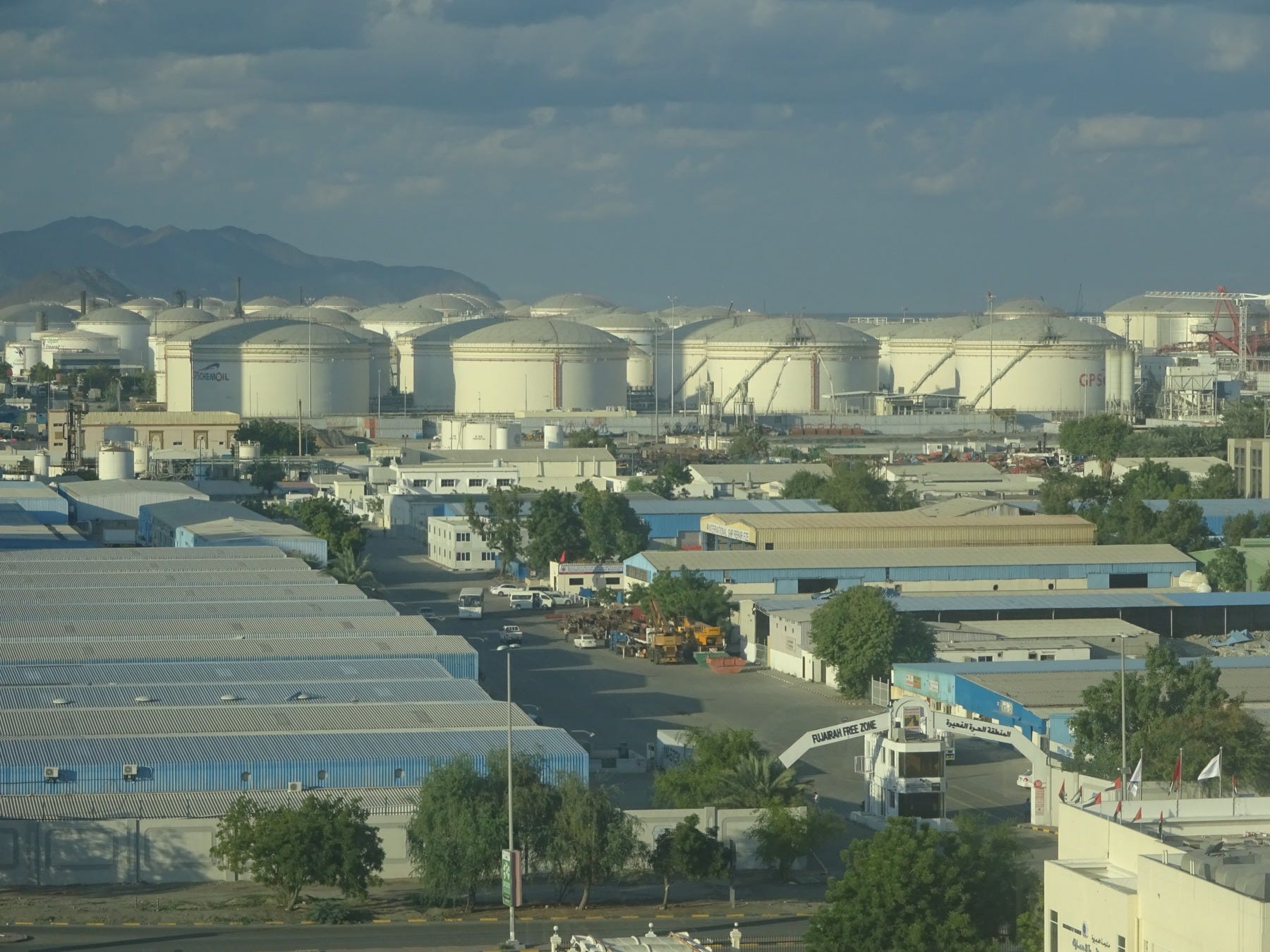
Morning. Steve Moore here. Reuters has traced how Iranian strikes disabled critical equipment at Fujairah, disrupting a route that lets the UAE export oil without passing through the Strait of Hormuz. Its investigation, published on Thursday, follows the port’s recovery from repeated attacks to record exports in September.
On the same day, senior Federal National Council member Dr Ali Rashid Al Nuaimi said the UAE was better prepared for renewed conflict. Abdulmunim Al Kindy, a board director at Abu Dhabi National Oil Company (Adnoc), described the backup infrastructure that helped the company maintain production.
If someone sent you this edition, subscribe to Emirates Wire for free each weekday morning. I follow the regional developments and practical changes affecting life and work in the UAE.
How the strikes disrupted Fujairah
Reuters records at least 19 Iranian attacks on the port since 28 February. Its satellite imagery analysis found that March strikes damaged two pipeline-transfer systems that route oil from terminals to ships. Four specialists and a person familiar with the damage supported its finding about the second system, which had not previously been reported.
After a drone strike on 4 May damaged pipes feeding the first transfer system, Reuters found, using Kpler shipping data, that refined-petroleum exports essentially stopped for a month. By September, refined-product exports had recovered, and the port’s combined crude and refined-product exports reached a monthly record, Reuters reports.
Gulf governments have frequently attributed damage to debris from intercepted missiles and drones, Reuters reports. All 14 specialists who reviewed its findings considered it highly improbable that falling debris primarily explained the damage to essential equipment at dozens of major sites. Reuters could not visit the sites to fully assess the damage or review every interception.
Asked about the findings, the UAE government called for renewed efforts to de-escalate regional tensions. Adnoc did not respond to Reuters’ detailed questions.
Al Nuaimi says readiness has improved
Al Nuaimi discussed the risk of renewed fighting with journalists in Dubai on Thursday. The chairman of the Federal National Council’s Defence, Interior and Foreign Affairs Committee said the country was “better prepared than it was on February 28”. He did not rule out renewed full-scale fighting, telling The National: “The war can resume, yes.”
He also said “hundreds” of people he described as members of Iranian sleeper cells had been arrested, including several Emiratis. He accused them of helping guide Iranian missile and drone attacks against the UAE, The National reported.
Al Nuaimi said dialogue remained a priority and that the UAE would respond to Iran’s steps to rebuild trust. For now, he said, “we don’t trust them”.
Adnoc credits years of contingency planning
At Adnoc, Al Kindy said the company had prepared for this scenario “10 years ago, 15 years ago”. Speaking on Thursday ahead of the ADIPEC energy conference, which he chairs, he said backup facilities and interconnections allowed Adnoc to change supply sources and delivery destinations.
Some were built “at great expense, even though at the time they didn’t make any commercial sense at the time”, Al Kindy said. Years of drills gave staff “almost muscle memory” when disruption came, and he credited those preparations with helping maintain production, The National reports.
Riyadh summit postponed; Houthis strike Aden palace
In Riyadh, the Gulf Cooperation Council (GCC) postponed its summit with the European Union, scheduled for 24 October, citing Houthi threats and the extended closure of King Khalid International Airport. The EU gave no reason for the delay in its statement, saying it would announce a new date “in due course”.
More detail has emerged about Tuesday night’s strike on Aramco’s headquarters in Dhahran. Two regional officials told the Associated Press that the top three floors were damaged, including the chief executive’s office and those of other senior officials, with no casualties. They spoke anonymously because they were not authorised to discuss the incident; Saudi Arabia’s Energy Ministry had reported a “limited fire” in an administrative building.
On Thursday, the Saudi-led coalition said it had intercepted a cruise missile in the Medina region, without identifying its origin in the statement. The Houthis denied attacking Medina, calling the allegation a “shameless and brazen lie”, CBS News reports.
In Yemen, Houthi missiles struck the Al-Maashiq presidential palace complex in Aden on Thursday. Information Minister Moammar al-Eryani said the prime minister and cabinet members there were unharmed. Two government officials told Reuters that two security guards were killed. AFP reported a higher toll, citing three government military sources who said at least four people were killed and 10 wounded, according to Khaleej Times.
The UAE operator behind the GFS ships
At sea, the loss of GFS Pride affects an operator majority-owned by AD Ports Group. Global Feeder Shipping lists the vessel in its fleet, and AD Ports announced in June that it had increased its stake in the Dubai-based company to 81%.
Singapore’s maritime authority confirmed on Wednesday that GFS Pride had sunk after damage and a fire, with all 21 crew safely evacuated. GFS Giselle, another vessel in the operator’s fleet, reached a safe anchorage under its own power with all 22 crew safe.
Iran’s mine explanation remains unconfirmed. Singapore’s statement cites reports of unknown projectiles, while maritime security firm Marisks says it has no independent evidence that a mine caused GFS Pride to sink, CNBC reports.
Sharjah announces arrests in Dh8.8bn laundering case
Sharjah Police announced 33 arrests on Thursday in an international investigation into alleged cyber fraud, digital-wallet theft, money laundering and violent intimidation. Police said the suspects came from 12 countries and that arrests took place in the UAE and abroad.
Attorney General Anwar Al Harmoudi said investigators had traced alleged laundering transactions worth Dh8.8bn (about £1.8bn) through bank accounts, digital wallets and other platforms. Police said they seized more than Dh200m (about £41m) and examined more than 3,000 digital wallets.
Investigators described four connected groups with different roles: stealing data, moving proceeds, manipulating victims into surrendering digital assets and using violence to obtain wallet passwords. These are the authorities’ allegations against the suspects, not findings of guilt.
A walk between the Metro and Etihad Rail
Passengers at Jumeirah Golf Estates Metro station on the Red Line can now walk to Etihad Rail’s Dubai Al Yalayis station through an enclosed footbridge. Khaleej Times reports that access is from Metro exits 1 and 2.
The route has escalators and moving walkways, and the transfer takes about five to seven minutes. Gulf News found the roughly 400-metre bridge accessible during a visit on Thursday, although some finishing work continued; it also confirmed that shuttle buses were still running between the stations.
In Sharjah, three new feeder routes serve Etihad Rail’s Al Dhaid station: ER1 from Al Madam, ER2 from Al Sajaa and ER3 from Jubail. Their timetables are aligned with train arrivals and departures, The National reports.
Drivers in Al Satwa now face traffic signals where the roundabout stood on 2nd December Street. The Roads and Transport Authority says the change cuts journey times through the junction by 50% and peak waiting times and queues by up to 60%.
What to watch today
Shipping: Any statement from AD Ports or Global Feeder Shipping on service changes, cargo handling or damage to the fleet.
Saudi Arabia: Further attacks, any US decision to intervene against the Houthis and an official reopening announcement for Riyadh airport.
Diplomacy: A replacement date for the EU–GCC summit and any substantive response in the US–Iran exchanges.
Thank you for reading. Please share this edition with someone planning a rail journey or following how the conflict is affecting the UAE.
I welcome your questions, corrections and first-hand accounts. Reply to this email, leave a comment or write to steve@emirateswire.co.uk.
If you try the new Metro-to-rail bridge this weekend, tell me how the transfer works with luggage. I’d like to hear about the signs, the walk and anything that makes the connection harder than it needs to be.
Steve
Emirates Wire uses AI tools to assist with research, early drafting, fact-checking and copy-editing. Steve Moore reviews, edits and personally approves every sentence before publication.