

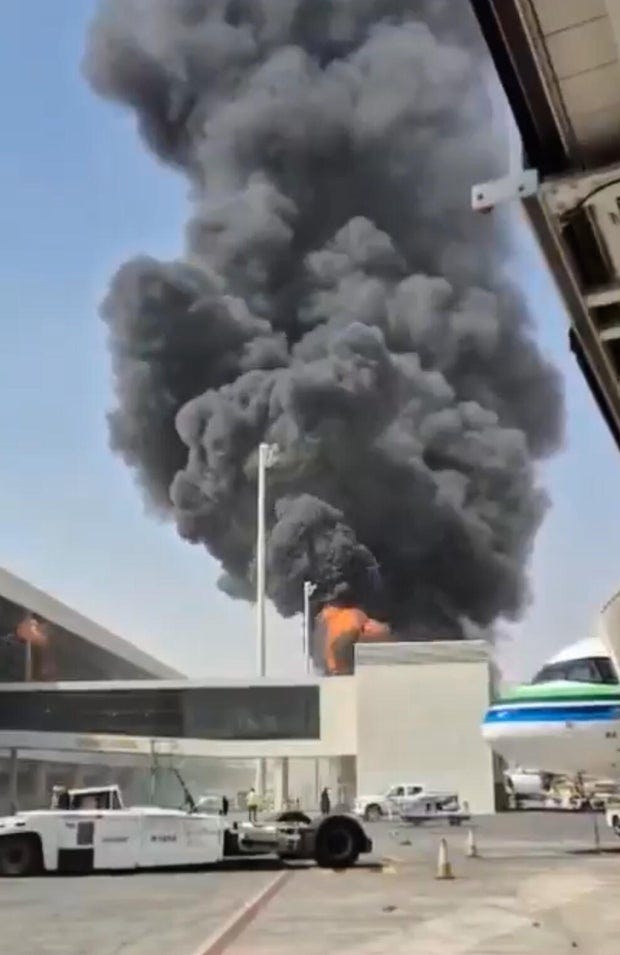
Smoke and flames rise at King Khalid International Airport in Riyadh on 9 October 2026, in an image from video obtained and verified by the Associated Press.
Morning. Steve Moore here. Riyadh’s airport was struck again on Sunday, a day after an attack killed at least 12 people and injured more than 300. The latest strike caused further injuries, Saudi authorities said, while UAE airlines extended cancellations on Saudi routes.
For the UAE, the weekend also brought reports of a tanker hit off Ras Al Khaimah and a Coast Guard rescue from a burning vessel. Those accounts have not been established as the same incident.
If someone forwarded this edition, subscribe to Emirates Wire for free each weekday morning. I follow the UAE’s news and explain what it means for people living and working here.
Another strike on Riyadh airport
A projectile hit King Khalid International Airport’s passenger-terminal complex on Sunday, the Saudi-led coalition said. Saudi authorities reported injuries but gave no number, the Associated Press said.
The previous day’s attack killed at least 12 people, including an American, and injured 309, according to figures from Saudi Arabia’s General Authority of Civil Aviation reported by CBS News. Those figures concern Saturday’s attack and do not include Sunday’s reported injuries.
The UAE condemned the Houthi attacks on the airport on Sunday and affirmed its solidarity with Saudi Arabia. Its foreign ministry described the attacks as a violation of Saudi sovereignty and a threat to the kingdom’s security.
Donald Trump said on Saturday that he was considering whether the US should join Saudi strikes against the Houthis in Yemen. “We may. We’re gonna look at it,” he told reporters.
Check Saudi flights before leaving home
The disruption now affects several UAE–Saudi routes. flydubai has cancelled Riyadh services through 14 October, including flights scheduled for that day, according to an airline statement reported by Gulf News.
Etihad’s live travel notice, checked on Sunday evening, lists selected cancellations between Abu Dhabi and Dammam, and Jeddah and Riyadh from 11 to 13 October. Gulf News also reported Emirates cancellations to Riyadh and Dammam for Monday.
Check your flight with the airline before travelling to the airport. Flydubai says affected passengers can seek a refund or rebooking through Manage Booking; those who booked through a travel agent should contact the agent.
Flydubai co-pilot studied route before alleged plot
In a separate aviation development, the UAE Attorney General said on Friday that the co-pilot accused of attacking the captain of flight FZ1073 had used two earlier flights to study the Tel Aviv route and airport. Prosecutors say he intended to seize the aircraft and crash it into Ben Gurion’s passenger terminal.
The suspect described a plan inspired by the September 11 attacks and claimed to have acted alone, according to the statement. Investigators are still examining possible accomplices and connections.
The inquiry also examined his recruitment. Prosecutors say he met flydubai’s professional and security requirements, but the checks revealed no indications of his extremist views or intention to carry out an attack.
A clarification to Tuesday’s edition: our report, citing the Wall Street Journal, said he was hired in February. The Attorney General’s statement says he joined flydubai in January 2026.
Tanker hit off Ras Al Khaimah
At sea, the Panama-flagged crude tanker Gem No.2 was struck by an unidentified projectile on Friday, about 13 nautical miles west of Al Jazeera in Ras Al Khaimah, according to Arab News, citing the United Kingdom Maritime Trade Operations agency (UKMTO). Firefighters extinguished the resulting fire, and no group had claimed responsibility.
The UAE National Guard separately announced on Saturday that its Coast Guard had rescued 22 crew members from a burning tanker in the Gulf. It did not name the vessel or give the cause of the fire, so the rescue cannot yet be identified as the Gem No.2 incident.
UKMTO also reported that ship masters near Ras Al Khaimah had received overnight radio instructions to leave their anchorages, Al Jazeera reported on Sunday. The account did not identify who issued those instructions.
Oil ends the week above $104
Brent closed on Friday at $104.72 a barrel. US supply also faced disruption: Hurricane Isaias had prompted producers to halt 72% of US Gulf of Mexico oil output by Friday, Bloomberg reported, citing the Marine Minerals Administration.
UAE output fell in the second quarter
The UAE’s real gross domestic product (GDP) grew 0.4% in the first half of 2026 from the previous year, reaching Dh961.9bn. In the second quarter, however, output fell 2.1% year on year.
The Federal Competitiveness and Statistics Centre’s preliminary estimates, published by the Emirates News Agency (WAM) on Friday, show non-oil activity grew 1.8% over the half-year but contracted 1.1% in the second quarter. The centre said regional developments and travel disruption affected tourism, transport and trade.
The first-half headline therefore gives an incomplete picture of the more recent slowdown. These are preliminary estimates, with a comprehensive revision of the national GDP series due in the first quarter of 2027.
Iran threatens technology infrastructure
Iran’s security chief Mohsen Rezaei has warned that US assets in the region, including communications cables, data centres and artificial intelligence facilities, could become targets if fighting resumes. Iran International reported his remarks on Sunday, citing state media; Press TV separately reported a conditional threat against American data systems.
The warning is relevant to the UAE’s AI expansion, where security was already under review. On 11 September, Reuters reported that the planned five-gigawatt UAE–US AI Campus would probably become a network of sites rather than a single Abu Dhabi campus, citing people familiar with the discussions. Officials were considering air defences and underground construction.
G42 told Reuters that work was progressing as planned and that the project’s details remained under continuous review. Reuters could not establish how close officials were to finalising a revised masterplan.
Driverless pods on trial at Bluewaters
In Dubai, the Roads and Transport Authority has begun a four-week trial of Glydways autonomous electric pods at Bluewaters Island. The trial will assess safety, reliability, journey times, and passenger experience before considering wider deployment.
A proposed 2.8km link between National Paints Metro Station and Bluewaters is under study. The vehicles carry four to six passengers, but the announcement is about testing the system, not opening that route as a public passenger service.
What to watch today
Saudi travel: Further airline cancellations and official information on airport operations after Sunday’s strike.
Shipping: Identification of the tanker involved in the UAE rescue and any further instructions for vessels off Ras Al Khaimah.
Washington: Whether the US considers strikes against the Houthis.
Oil: Monday’s opening and the pace at which US offshore production can resume.
Thank you for reading. Please share this edition with someone whose work or travel takes them between the UAE and Saudi Arabia.
I write and edit Emirates Wire, and welcome your questions, corrections and first-hand accounts. Reply to this email, leave a comment or write to steve@emirateswire.co.uk.
If your Saudi travel plans have changed, I’d like to hear how your airline handled the disruption. Safe travels this week.
Steve
Emirates Wire uses AI tools to assist with research, early drafting, fact-checking and copy-editing. Steve Moore reviews, edits and personally approves every sentence before publication.
An important strategic lesson here is that the consequences of an attack on critical infrastructure extend far beyond the immediate physical damage.
An airport is not merely a transport facility; it is part of a wider network connecting trade, mobility, investment, and regional economic confidence. When its operations are disrupted, the effects can spread across airlines, supply chains, business activity, and the freedom of movement on which regional connectivity depends.
From a field-informed strategic perspective, the key question is not only whether an attack achieves its immediate objective, but how its wider effects reshape the choices available to governments, businesses, and civilian populations. Disruption can impose costs well beyond the point of impact, particularly when several interconnected systems are exposed to pressure at the same time.
This is why protecting critical infrastructure must be understood as part of broader strategic resilience: the ability to absorb disruption, maintain essential functions, adapt, and recover without allowing a tactical attack to produce lasting strategic consequences.
The wider regional implications deserve as much attention as the immediate incident itself.