

Registration for the evening is here: https://events.emirateswire.co.uk/
Attendance is free and on the record.
In the week before 9 September, everyone who has registered will receive an email inviting them to submit a question in advance. We will read every one, and they will shape what we put to the panel on the night.
In every regional crisis, there is a moment when the interesting question is no longer what has happened. It is what it costs.
For the UAE, that moment is now.
Oil has spent the summer trading more on geopolitics than fundamentals. Insurers have re-priced Hormuz, even on days when tankers keep moving. Gulf issuers who came to market in the first quarter with tight spreads are meeting investors who now want more for the same paper. Dubai’s tourist arrivals are below the pre-crisis trend. Top-end property in Abu Dhabi and Dubai has slowed. The dirham’s peg is holding as designed, and the fiscal picture beneath it is evolving month to month.
None of this reads as a crisis in the visible sense. That is what makes it worth talking about. The UAE is not a country in distress. It is a country keeping an open economy open while the region around it is not, and managing it as much on the money side as on the diplomatic one.
That is the conversation we are hosting in London on 9 September.
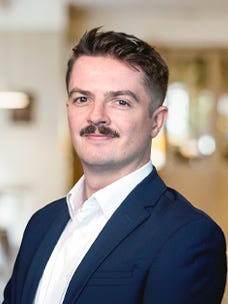
We’ve asked James Swanston to lead us into it.
About James
James is an economist covering the Middle East and North Africa in the EEMEA Economics Team at Barclays. He is responsible for analysing and forecasting Barclays’ view on the region.
He joined Barclays in March 2026 from Capital Economics, where he had spent nine years on MENA and the wider emerging market landscape. In those nine years, he was named FocusEconomics’ top forecaster of the year for Kuwait, Saudi Arabia and Qatar. It’s a practitioner distinction — most visible to people who read Gulf forecasts for a living — which is the audience that tests forecasts against outcomes.
He holds an MSc in Economic History from the London School of Economics, where he researched Egypt under IMF programmes, and a BSc in Economics from the University of Bath.
There is no shortage of people in London willing to offer a view on the UAE. Far fewer have been forecasting it for the better part of a decade and been right often enough for the record to show it.
What we are asking him
What has actually changed in the Gulf economy since the conflict widened, and what has not. Headlines and data do not always agree; it matters which you trust and why.
Where the money is going now: into the Emirates, out of the Emirates, and around them. The flows assumed a year ago are not the flows we are seeing.
Which UAE sectors are absorbing the shock and which are exposed — tourism, property, banking, logistics, energy trading, the free zones — and what the dispersion tells us beyond the averages.
What the market is pricing for Gulf risk today, and whether that pricing aligns across insurers, ratings agencies, and issuers. If it diverges, where might the mispricing sit?
What further escalation looks like on the balance sheet, not just on the news. Where does a bad month become a structural break?
What the UAE is actually doing in response — policy, market operations, and signalling — and how effective those moves appear so far.
Who else is there
James will be joined by Sir Oliver Dowden KCB CBE MP, chair of the UK-UAE All-Party Parliamentary Group, and Dr Burcu Ozcelik, Lead of the Middle East, North Africa and Turkey Security Programme at RUSI. David Waddell, senior business producer and reporter at BBC News, is chairing.
We will come to Oliver and Burcu later this week. But 9 September is not a Westminster event, and it is not a security think-tank event. It is a discussion about a country that runs on money, in a region that has stopped behaving predictably. It made sense to start with the person we asked to speak to the money side.
The evening
The UAE and the widening Gulf conflict: what happens next?
Venue: National Liberal Club, 1 Whitehall Place, London SW1A 2HE
Date: 9 September
Programme: drinks from 6.00 pm; discussion at 7.00 pm
Registration:
https://events.emirateswire.co.uk/