

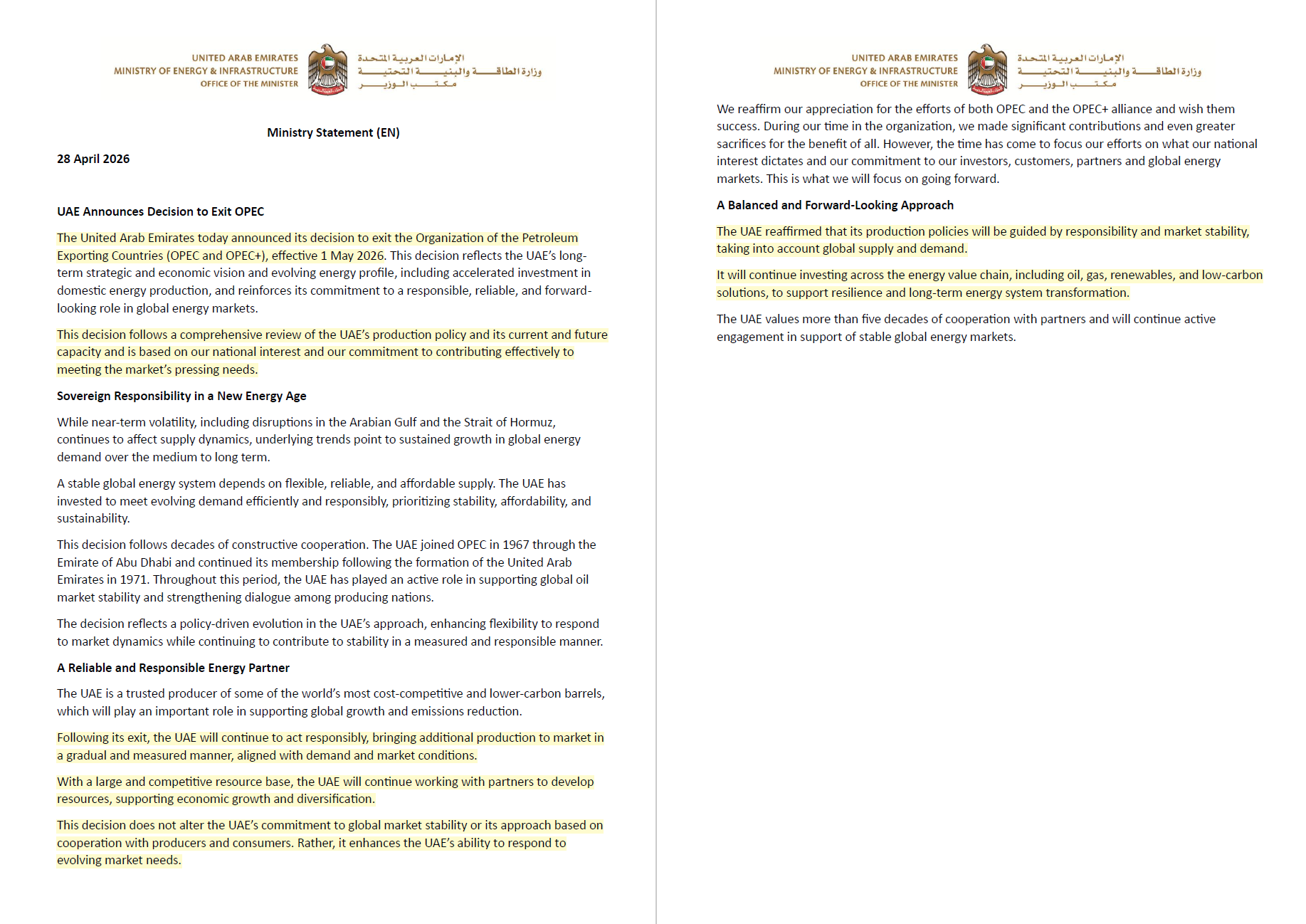
The UAE has just made one of the most consequential energy decisions in its history. In a statement published via the WAM state news agency today, Abu Dhabi confirmed it will withdraw from OPEC and the wider OPEC+ alliance, effective 1 May 2026. Two days’ notice. Fifty-three years of membership, ended.
This is not a rumour. This is not a negotiating tactic. It is done.
What the UAE Actually Said
The official statement from WAM was brief and carefully worded. Abu Dhabi said the decision “reflects the UAE’s long-term strategic and economic vision and evolving energy profile, including accelerated investment in domestic energy production.” It spoke of a “comprehensive review” of the country’s production policies and a commitment to a “responsible, reliable, and forward-looking role in global energy markets.”
What it did not say — but what every analyst in the room understood — is that this is also a statement about the war.
The Iran War Context You Cannot Ignore
Since 28 February, the UAE has absorbed more Iranian drone and missile strikes than any other nation. It has watched the Strait of Hormuz — through which roughly 20% of the world’s oil and gas normally passes — effectively close. It has sat inside OPEC, bound by production quotas negotiated in calmer times, while its own infrastructure has been targeted and its own economic model tested.
The UAE did not seek this war. Gulf Arab leaders explicitly opposed it. And yet the UAE has borne a disproportionate share of the consequences — and has received, by its own assessment, an inadequate response from fellow Arab states.
Against that backdrop, today’s move is not simply an energy policy decision. It is the UAE asserting, unmistakably, that it will now act in its own interests. It will produce what it chooses to produce, when it chooses to produce it.
The Numbers That Drive This
The UAE’s exit has long been forecast to deliver extraordinary financial upside. Research from the Baker Institute, published in 2023 when the scenario was still theoretical, estimated that departing OPEC could bring the UAE upward of $50 billion in additional yearly revenues based on its spare production capacity alone. Abu Dhabi has been steadily building toward a production target of five million barrels per day. Inside OPEC, quota constraints have prevented it from reaching that ceiling. Outside, nothing does.
OPEC+ had already announced a production adjustment of 206,000 barrels per day from May 2026 — a figure that will now be recalculated entirely without the UAE’s capacity in the equation.
How the World Is Reacting
Washington is welcoming it. President Trump, who has repeatedly accused OPEC of “ripping off the rest of the world,” is expected to see this as vindication. The UAE’s decision to break from the cartel — and signal its preference for market-driven production — aligns closely with the US administration’s energy policy objectives.
Saudi Arabia has not yet formally responded. That silence is significant. The Saudi-UAE relationship, already strained publicly this year over Yemen, has now absorbed the single most consequential act either country could take within the framework of their shared energy architecture. The prospect of a price war — in an already disrupted market — cannot be dismissed.
Oil markets are processing what analysts are describing as a “structurally weaker OPEC” — with consequences not just for today’s price but for the cartel’s long-term ability to smooth supply shocks. If the UAE, the third-largest OPEC producer after Saudi Arabia and Iraq, can walk away, others will ask whether they should too.
On the Strait of Hormuz itself, Sky News is reporting a notable development today: the first LNG tanker has crossed the strait since the conflict began — a fragile signal of possible easing, though no peace agreement is in place and Trump has indicated he remains unsatisfied with Iran’s latest proposals.
What This Changes for the UAE — and for You
For people living, building, and investing in the UAE, this moment demands clarity rather than alarm.
The short-term effects are real. Greater production freedom means greater revenue for Abu Dhabi — and a sovereign wealth base that was already estimated at 184% of GDP is about to get more fuel. The UAE’s structural resilience is not diminished by this decision; it is arguably strengthened.
The medium-term complexity is also real. A fractured OPEC in a war-disrupted energy market creates volatility. Oil price movements in either direction — a supply surge from UAE, a retaliatory cut by Saudi Arabia, a further escalation around Hormuz — will have direct consequences for the UAE economy, particularly its non-oil sectors which now account for the majority of GDP.
The long-term signal is this: the UAE is repositioning itself as an independent energy power, not a cartel member. It is making a bet on its own capabilities, its own diplomacy, and its own future. For a country that has spent three decades systematically reducing its dependence on oil revenues, this is less a pivot than a culmination.
The Emirates Wire View
This is a founding-moment decision. Whatever you think of the timing — and reasonable people will differ — it is hard to argue with the logic. The UAE entered this war as a member of a collective energy structure that could not protect it, could not adequately respond on its behalf, and constrained the very revenues it needed to absorb the shock. Leaving was rational.
The harder questions now follow fast. What does OPEC look like without the UAE? How does Saudi Arabia respond? Can the Hormuz situation stabilise before the UAE’s new production freedom collides with a still-disrupted shipping route? And — the question every business in this country is asking quietly — what does an assertively independent UAE energy strategy mean for the recovery that lies on the other side of this conflict?
We will keep you ahead of every development.
Emirates Wire is your essential intelligence platform for the UAE — honest, clear, and always ahead of the story. If someone forwarded this to you, you can join our community [here].