Draft Iran deal circulates as attacks hit Gulf shipping
Abu Dhabi signs four OpenAI agreements and calls for stronger energy infrastructure; new traffic rules take effect in January.

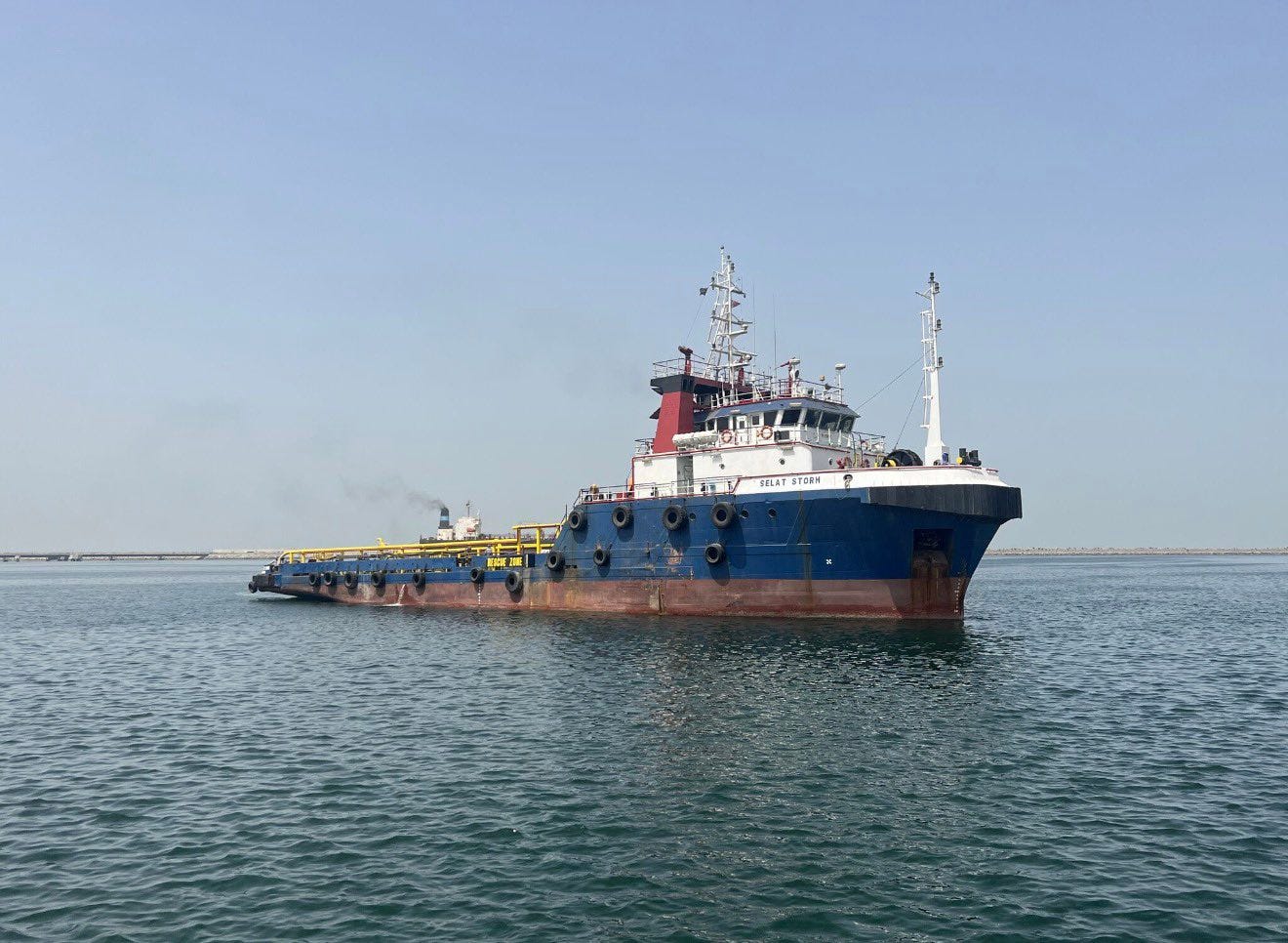
“The offshore tug Selat Storm in an undated file photograph.” Credit: Selat Marine Services
Iran’s negotiators have left Doha with a draft proposal circulating, an official briefed on the talks told Reuters. Tehran says reopening the Strait of Hormuz depends on Washington ending its naval blockade and meeting Iran’s demands. Meanwhile, reports of attacks on a UAE-owned tug and a tanker off Saudi Arabia have added to the dangers facing Gulf shipping.
In Abu Dhabi, Energy Minister Suhail Al Mazrouei called for stronger infrastructure to withstand supply disruptions. Abu Dhabi-based institutions also signed four agreements with OpenAI, including a government project whose first food-imports pilot is already operating. For residents, the new traffic regulations limit vehicle registrations and give licensing authorities powers to act when owners ignore recalls.
Subscribe to Emirates Wire for the UAE stories that deserve a closer look. We follow the regional decisions and the practical changes that reach your working day.
Iran sets conditions for reopening Hormuz
The Iranian delegation departed on Sunday, but the official who spoke to Reuters said this was “not because of difficulties”. A follow-up meeting remained possible, and the official gave no details of the draft.
Foreign ministry spokesman Esmaeil Baghaei said an agreement could not begin, and Hormuz could not reopen or be secured, until the US ended its blockade and addressed Iran’s demands. Iran has proposed reopening the waterway within two days under a deal, shortening the seven-day timetable it previously offered.
Donald Trump, speaking at a rally in Iowa on Sunday, said that “at some point we’re going to have to give them the hammer”, Middle East Eye reported. He also said he wanted to save lives; the remarks did not announce a new operation or a date for one. Americans vote in the midterms on Tuesday.
A tug hit near Musandam
While the draft circulated, maritime security reports described further attacks at sea. Vanguard Tech identified the offshore tug Selat Storm as the UAE-owned vessel hit by a projectile north-west of Oman’s Musandam Peninsula on Sunday, shortly after leaving Al Hamriyah. The company described it as “partially sinking”; The Maritime Executive said the crew’s condition had not been reported.
Later on Sunday, UK Maritime Trade Operations reported that two projectiles had struck a tanker about 72 nautical miles east of Ras Al Khafji, off Saudi Arabia, according to shipping publication Splash247. All crew were accounted for, and no pollution was reported. The reporting did not establish who carried out either attack.
The UAE’s foreign ministry on Monday condemned the attack on Qatar’s Al Mayeda, calling it a “dangerous escalation” that threatened navigation and energy supplies. Its statement did not identify an attacker.
Oil falls on hopes for talks
The shipping attacks did not prevent a sharp fall in crude prices on Monday as investors weighed the prospect of diplomacy. At 13:57 GMT, January Brent futures were down $6.78, or 6%, at $106.65 a barrel, Reuters reported; US West Texas Intermediate crude was down $6.37 at $97.75. Iranian President Masoud Pezeshkian said the supreme leader had granted the government “certain authorities” over peace talks, without specifying them.
Mazrouei calls for stronger supply routes
Speaking on Monday at the Abu Dhabi International Petroleum Exhibition and Conference (ADIPEC), Al Mazrouei said earlier investments in pipelines, ships and logistics had helped the country maintain supplies during the conflict. The country had to prepare for the worst because it “cannot predict what’s going to happen”, he said.
Bloomberg reported his call for alternative supply routes and spare capacity, as well as storage abroad to bring producers closer to their customers. Sultan Al Jaber, chief executive of Abu Dhabi National Oil Company (ADNOC), also urged investment in stockpiles and infrastructure, saying energy security must be measured at the point of delivery.
ADNOC also approved investment in its Ruwais Diyab unconventional gas development on Monday. The company says the project will supply 345 million standard cubic feet of raw gas a day from 2029 for 25 years, with processing facilities and pipelines connecting it to the UAE network. The announcement gave no capital cost.
Four OpenAI agreements, including a working pilot
ADIPEC also brought OpenAI chief executive Sam Altman to Abu Dhabi, where he met Crown Prince Sheikh Khaled bin Mohamed. The Abu Dhabi Media Office announced four agreements, covering oil operations, government services and investment analysis, alongside a wider five-year adoption programme.
ADNOC will work with OpenAI and G42, through its subsidiary Inception42, to apply artificial intelligence (AI) to operational, investment and commercial decisions. Separately, Mubadala will work with Inception42 and OpenAI on investment analysis and risk assessment.
The government agreement translates a defined set of regulations into a form that AI systems can use to help officials check compliance. Its first pilot is already operating at the Abu Dhabi Agriculture and Food Safety Authority, focusing on food imports. Each assessment must be traceable to the relevant rule, and government officials retain responsibility for final decisions.
The fourth agreement gives Inception42 and OpenAI a five-year programme to support adoption across government, businesses and education. The announcement disclosed no financial terms.
Some visiting oil executives had cancelled their plans: Reuters reported last week, citing two sources, that ExxonMobil chief executive Darren Woods and Chevron upstream president Clay Neff would not travel because of security concerns. Both companies declined to comment.
Vehicle registrations capped from January
For individual residents, the traffic regulations taking effect on 1 January 2027 allow two vehicles under the standard arrangements, with an additional registration or renewal fee for each vehicle above that, up to five licensed vehicles. Article 89 does not specify the extra fee or explain how it will treat existing holdings above five.
The same regulations require commercial agents to notify authorities about manufacturing defects and arrange repairs free of charge. If an owner ignores a recall, licensing authorities may restrict procedures or transactions associated with the vehicle’s chassis number. That restriction is discretionary; Article 122 does not set a response deadline or identify particular transactions that must be blocked.
Dh50,000 cap on implementation fines
The Ministry of Finance announced on 30 October that specified failures to implement electronic invoicing carry an initial Dh5,000 penalty, followed by Dh5,000 for each month or part of a month the breach continues. Those penalties are capped at Dh50,000 in any 12 consecutive months.
The revision also removes the penalty for failing to notify the Federal Tax Authority about an e-invoicing system failure. The Dh50,000 ceiling applies to the specified implementation breaches; businesses should check the penalty attached to each obligation rather than treat it as a cap on every e-invoicing fine.
Flag Day and the week ahead
Tuesday is Flag Day and the start of Brand Dubai’s National Month, which runs until 2 December. The programme includes Flag Garden and the UAE Parade, with further activities to be announced.
For travellers, Etihad’s cancellations through 5 November cover all Riyadh and Dammam services and selected Jeddah flights: EY601, EY602, EY603 and EY604, according to Khaleej Times. Check the flight number with the airline before travelling.
The diplomatic questions are whether Washington will accept further talks and whether Qatar will convene a follow-up meeting. At sea, confirming the condition of Selat Storm’s crew remains a priority.
If this briefing would help someone understand the decisions affecting life in the UAE, please share it. Stories, tips and perspectives are welcome at steve@emirateswire.co.uk.
Thank you for reading. Enjoy Flag Day, and send me the local stories the international headlines are missing.
Emirates Wire uses AI tools to assist with research, early drafting, fact-checking and copy-editing. Steve Moore reviews, edits and personally approves every sentence before publication.
Thank you, Steve! I particularly appreciated the distinction between what is known, what has only been reported, and what remains undisclosed. That restraint makes the regional security and AI sections much more valuable.
Your article brings together three critical dimensions of the current regional environment: diplomatic negotiations, maritime security, and the resilience of energy infrastructure. What makes this combination particularly important is that these are not separate developments; they are interconnected elements of a much broader strategic equation.
However, I believe there is a deeper dimension worth exploring: the relationship between strategic resilience, economic interdependence, and strategic independence.
The Strait of Hormuz is not simply a geographical passage through which energy moves. It is a strategic space where geography, economic interests, military capabilities, political calculations, and the vulnerabilities of interconnected systems converge. Its importance extends far beyond the immediate interests of Iran, the United States, or the Gulf states. It affects the wider architecture of regional and international security.
One important distinction deserves attention: resilience is not necessarily independence. Alternative pipelines, diversified supply routes, storage capacity, and stronger infrastructure can reduce vulnerability, but they do not automatically eliminate strategic dependence. True strategic independence requires a deeper understanding of the environment in which power operates: geography, resources, time, populations, economic relationships, political interests, and the capabilities of relevant actors.
There is also a fundamental question behind the current situation: when economic interdependence becomes an instrument of political or military pressure, how do states protect their national interests without creating new forms of dependency or escalating the very vulnerabilities they seek to overcome?
From a field-oriented strategic perspective, developments such as these should be examined beyond their immediate operational or diplomatic outcomes. A tactical advantage, a temporary negotiation position, or an infrastructure solution does not necessarily produce a sustainable strategic outcome. The decisive test is what follows: how actors adapt, how societies absorb the consequences, how regional relationships evolve, and whether the resulting arrangements create lasting stability or simply redistribute vulnerability.
This is where the distinction between responding to a crisis and understanding the strategic environment becomes essential.
Your article provides a valuable starting point for this broader discussion. I would be particularly interested in exploring whether the Gulf states can move from infrastructure resilience towards genuine strategic autonomy in an environment where geography and economic interdependence remain powerful instruments of influence.
Thank you for bringing these interconnected developments into one discussion. This is precisely the kind of subject that deserves deeper strategic examination.