Dubai invites the world's money in
For twenty years, the Gulf’s role in global finance was simple.

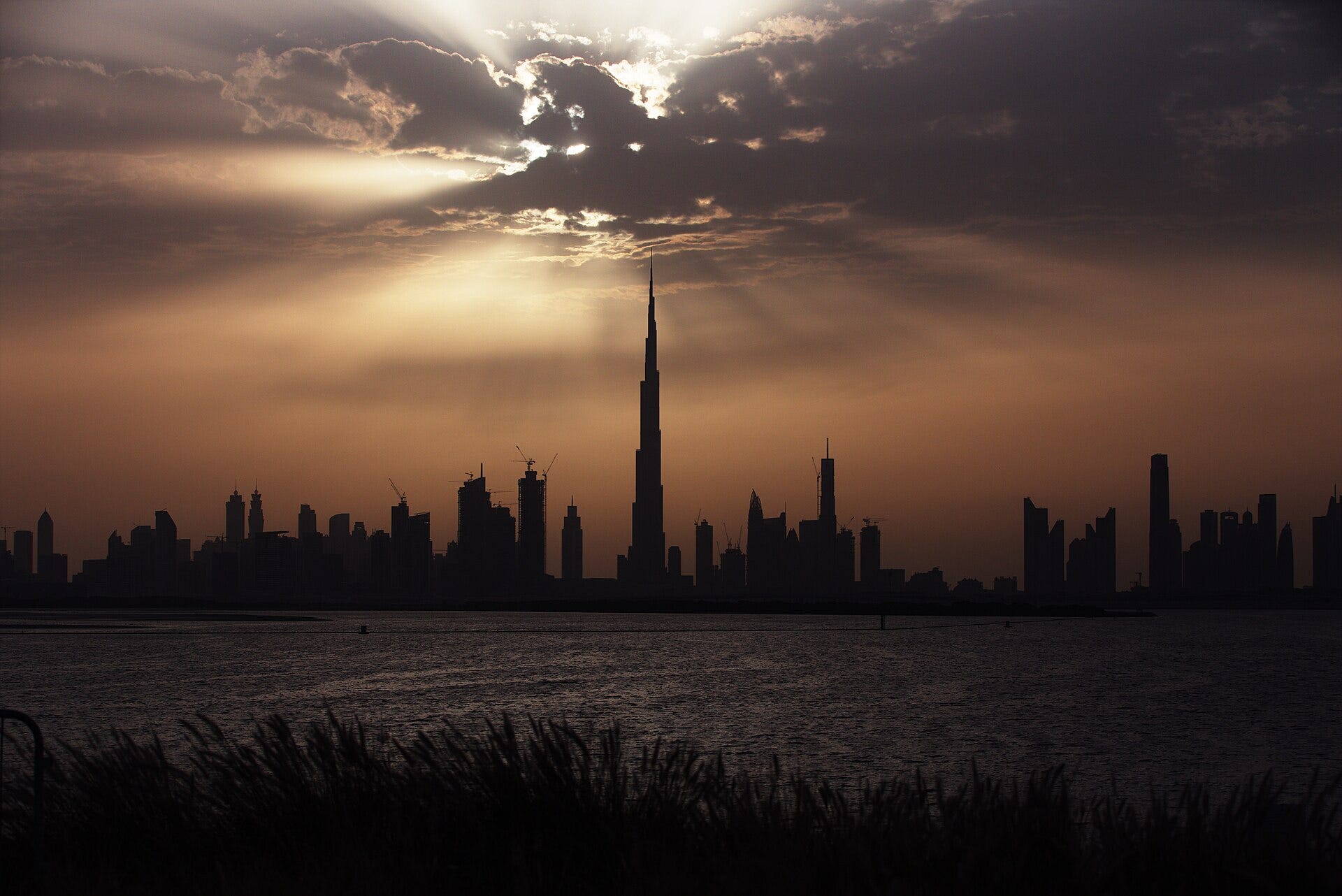
Photo: Imran Shahabuddin, CC BY 2.0
For twenty years, the Gulf’s role in global finance was simple. It earned money from oil and gas, parked it in sovereign funds, and sent it abroad to buy football clubs, office blocks and slices of Silicon Valley. On Thursday, at the first Bloomberg Invest Dubai, the UAE’s investment minister and its best-known developers delivered a different message. They want other people’s money to help build the country at home, and they argued that more than eight months of conflict with Iran have made the case stronger.
The half-day forum for family offices and fund managers was co-hosted by Dubai’s Department of Economy and Tourism, so nobody expected gloom. The news site Semafor put it neatly: the speakers “can be forgiven for talking up their own book.” Even so, some speakers were candid about where the strain shows.
The government’s pitch
The UAE’s Minister of Investment, Mohamed Hassan Alsuwaidi, told Bloomberg’s Guy Johnson that the country had come through the conflict “exceptionally well” and that he saw no slowdown. “We see more opportunities for investors, bigger projects coming to life,” he said. “AI is booming, logistics is booming, air freight is becoming a bigger business.”
The UAE hosts sovereign investors managing more than $2 trillion, so it hardly lacks capital. Alsuwaidi still wants private money in projects the state used to pay for alone: “I don’t see a challenge in the UAE on the funding front. I see opportunity to attract third-party capital in ways we haven’t in the past.” Energy, industrial and infrastructure projects will open to outside investors through public-private partnerships, deals with federal and local governments, and the privatisation of some state assets.
The conflict exposed how much of the Gulf’s trade depends on one narrow channel, the Strait of Hormuz, so the UAE is now investing in pipelines and ports that bypass it, including more capacity at Fujairah on the east coast. The banks are raising money too: First Abu Dhabi Bank is preparing the country’s largest rights issue, seeking up to Dh15 billion ($4.1 billion), partly to fund infrastructure expansion.
Alsuwaidi also pointed to gaps in the property market. Offices and warehouses are in short supply, he said, and on housing “we can’t keep up with the demand, so we keep building.” He wants investors to take a sovereign fund’s view of returns, meaning high single-digit or low double-digit percentages held for years: “If you can make a long-term, high single or low double for the long term with high certainty, I’d take that any day.”
The official figures support part of his case. UAE foreign direct investment rose about 6 per cent last year to a record $48.24 billion, the ninth-highest total in the world according to UN Conference on Trade and Development data. This year has been harder. Since the conflict began in late February, the UAE has been attacked with hundreds of missiles and drones, which damaged civilian infrastructure and energy sites. The economy still grew 0.4 per cent in the first half of 2026, carried by non-oil activity, which now makes up 79.2 per cent of GDP. Growth is thin, but under that kind of attack it is respectable.
Alabbar opens the books
The most revealing session came from Mohamed Alabbar, founder of Emaar Properties, the developer behind the Burj Khalifa. Dubai’s most reliable optimist stayed optimistic, but he also gave figures no tourism brochure would print.
Footfall at Emaar’s malls is down about 10 per cent, he said, after growing roughly 10 per cent a year for five years. Retail sales are down about 10 per cent too, and hotel occupancy has dropped from around 80 per cent to about 65 per cent.
Emaar’s own results show a bigger drop in property. Its UAE property sales have halved, from Dh52.9 billion in the first nine months of 2025 to Dh26.2 billion in the same period this year, and group sales are down about 43 per cent. Alabbar puts that down to pricing discipline: Emaar “does not believe in” markdowns and has not cut prices to shift units. The world, he said, is “in a winter.”
Construction has not slowed. Materials are still arriving, costs are up about 5 per cent, and Emaar is helping contractors absorb the increase. “I’m glad contractors are moving on time,” he said. “In fact, we deliver ahead of time now.”
The exception is “a big tower”, which Alabbar won’t put out to tender until the “situation cools down.” He didn’t name it. The regional business newsletter Enterprise notes that in January he said the Dubai Creek Tower would go to tender within three months, and that the tender then slipped after port closures pushed up material costs in June. Emaar had been expected to spend more than Dh14 billion on that tower and the adjoining Creek Mall.
His recovery timetable depends on events outside Dubai’s control. “It will all depend on what happens between Donald Trump and the Iranian leadership,” he said. “That’s really the key to everything.” If an agreement came within a month, he thought the market would need about 12 months to return to good shape. He dismissed fears of a property crash: “I would say that if there was a bubble, it would have burst.”
Meanwhile, Emaar keeps spending. In June it announced a Dh200 billion ($55 billion) Dubai megaproject designed to house nearly 150,000 people, and it has since unveiled a $3.3 billion business district at Dubai Creek Harbour with 300,000 square metres of commercial space. Last week it offered Dh15 a share in cash for the just under 20 per cent of Emaar Development, its listed construction arm, that it does not already own. The offer values the unit at about Dh60 billion ($16.3 billion) and closes on 10 December. Even at Dh15, the price is about a quarter below where the shares stood in February.
Alabbar is also looking abroad. India “will be a major [market] for us” over the next five years, he said, and Eagle Hills, his separate development company, is working on two large projects in Syria under a framework agreement signed in October.
The money coming in
If the UAE’s hosts were selling, Blackstone was buying. The world’s largest alternative asset manager has put more capital into the region over the past year than ever before, according to Farhad Karim, chief operating officer of its private wealth business. “The opportunity set is extraordinary,” he said. “Just driving around Dubai, it’s incredible what you see that needs capital.” On AI infrastructure, he said the firm is “doubling, tripling, quadrupling” its commitment, even though attacks earlier this year targeted Amazon Web Services data centres in Dubai and Bahrain.
During the conflict, Blackstone has partnered with a Dubai firm on an aircraft-leasing venture and committed $250 million to an Abu Dhabi payments platform. On Thursday, it opened an office in the Dubai International Financial Centre (DIFC), the city’s financial free zone. According to Bloomberg, the office is its first dedicated private wealth base outside Zurich.
Fundraising from institutions has slowed across private markets, so Blackstone is courting wealthy individuals and family offices instead. Its private wealth arm already manages $330 billion of its $1.4 trillion total, and Bloomberg reports that family offices in Dubai alone control more than $1 trillion.
Christian Stracke, president of the bond investor PIMCO, approached the same opportunity as a lender. The region’s capital spending needs are “massive,” he said, beyond what local banks and conventional government-linked financing can provide.
Sajwani’s money is travelling
Hussain Sajwani, founder of Damac and Dubai’s other famous developer, is sending money the other way. Speaking about his personal stakes in OpenAI, SpaceX and Anthropic, he said: “What I have made in 30 years, I made in Anthropic in less than two years.”
His data centre business, Damac Digital, operates in 14 countries and plans to raise its pipeline from about 6 gigawatts to 10 gigawatts by the end of 2027. About $9 billion of his $20 billion US pledge, announced alongside Donald Trump in January 2025, has been invested. Over the next 12 to 18 months, he wants more land outside the US, and he said he is in serious negotiations for a large site in Australia and another in the UK. He added that data centre build costs have risen about 30 per cent and could rise another 20 to 30 per cent.
British readers should note the UK site. Dubai money is still travelling, and some of it may soon buy British land and the grid connections that come with it.
Two economies
The day showed two economies running side by side. The economy that depends on shoppers, tourists and home buyers has slowed sharply, and Dubai’s biggest developer says so openly. The construction economy of towers, ports, pipelines and data centres continues, with foreign money increasingly invited in to share the cost and the risk.
Whether that invitation succeeds depends less on Dubai’s pitch than on the conflict. Alabbar’s 12-month recovery begins only once Washington and Tehran reach an agreement, and he gave no date. Meanwhile, the government is opening state projects to outside money, and Blackstone, PIMCO and others are buying in while valuations are down.
Discussion about this post