New Bahrain attack as Iran holds talks in Oman
One Indian seafarer missing after tanker attacks. Dubai airport traffic falls 28%; Silal tests the economics of desert farming.

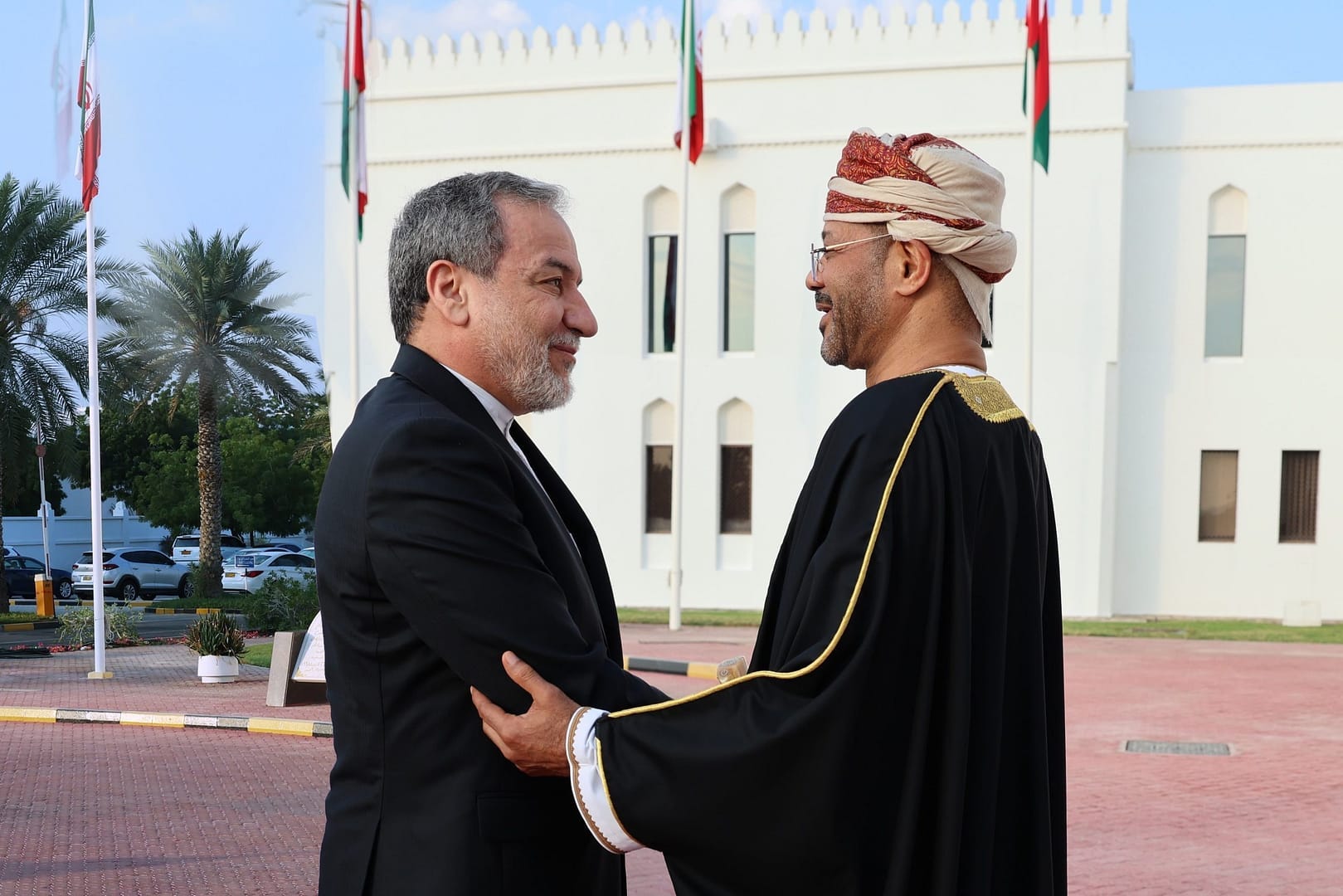
Caption: Oman’s Foreign Minister, Sayyid Badr Albusaidi (right), greets Iran’s Foreign Minister, Abbas Araghchi, at the Foreign Ministry in Muscat on Tuesday 17 November.
Credit: Photo: Oman Ministry of Foreign Affairs
Good morning. Bahrain says it intercepted another Iranian drone attack on Tuesday, as Iran’s foreign minister held talks in Muscat about protecting shipping and preventing further escalation. India has named the gas tanker attacked in Hormuz and says one Indian seafarer remains missing.
Bahrain intercepts drones
Iran’s Revolutionary Guards said they targeted a radar system at Bahrain’s Sheikh Isa base. Bahrain said it intercepted the attack, with no casualties or damage reported.
The UAE condemned the renewed attack, calling it a “flagrant violation” of Bahrain’s sovereignty. Tuesday’s attack followed further drone attacks reported by Bahrain on Sunday.
In Muscat, Iranian Foreign Minister Abbas Araghchi met his Omani counterpart, Badr Albusaidi, and Sultan Haitham bin Tariq. Oman’s foreign ministry said the discussions covered maritime routes, international shipping, and efforts to revive dialogue; the report said no agreement was announced.
Donald Trump said he might hold off from attacking Iran if there were no further provocations from Tehran or Yemen’s Houthis. He said the US naval blockade of Iran would remain.
Search continues for missing seafarer
India has identified the vessel as MT Tara Gas, a Panama-flagged tanker carrying liquefied petroleum gas. Its foreign ministry condemned an attack on the ship on Monday.
A further strike forced the crew to abandon the vessel, India’s shipping minister, Sarbananda Sonowal, said on Tuesday, according to Gulf News. The first attack was reported about seven nautical miles north of Khasab, Oman.
Of the 24 Indian nationals aboard, 21 had been safely evacuated ashore at Khasab, two were in hospital, and one remained missing, India’s foreign ministry said. The Indian embassy was coordinating with Omani authorities on the search-and-rescue operation.
The ministry did not identify the attacker. It called for attacks on commercial shipping to end and for free navigation through international waterways to be restored.
Dubai airport traffic falls 28%
Dubai International handled 50.4 million passengers in the first nine months of the year, down 28.1% from the same period in 2025, its operator said. Reuters reported that conflict-related disruption had affected regional travel.
Third-quarter traffic was 18.8 million, down 22.1% year on year, with August accounting for 6.6 million. Dubai Airports chief executive Paul Griffiths expects the airport to handle more than 70 million passengers this year.
Etihad has extended the cancellation of all passenger and cargo flights between Abu Dhabi and both Riyadh and Dammam through Monday 30 November. Check your flight with the airline before travelling to the airport.
Vodafone sale lifts company profits
Gulf News reports that profits at Abu Dhabi-listed companies rose 19% in the third quarter, while Dubai-listed companies recorded growth of 3.42%. Excluding foreign listings, the Dubai companies’ combined profits fell 3.34%.
A large part of the overall increase came from Etisalat’s sale of its Vodafone stake, according to the newspaper. The telecoms group reported an approximately Dh8bn gain on the sale and third-quarter net profit of Dh11.2bn, or Dh3.2bn after adjusting for that gain.
L’imad separately increased its indirect holding in Abu Dhabi Aviation to 71.61% after buying shares from a Mubadala subsidiary, Enterprise reported. The financial terms were not disclosed.
Abu Dhabi’s benchmark share index closed up 0.91% at 9,771.15 on Tuesday, while Dubai’s rose 0.58% to 6,248.03. Brent was quoted at $92.96 a barrel at 19:42 GMT on Tuesday, up 0.6% from the previous close.
Silal tests the economics of desert farming
Scientists at Silal’s $200m farming-technology incubator are testing ways to grow crops in extreme heat and salty groundwater, Bloomberg reports. Silal, the food producer created by the Abu Dhabi government, has brought together researchers from 20 countries at the three-year-old facility.
The work includes testing materials to keep greenhouses cooler and robots that can judge when fruit is ripe. Bloomberg identifies three technologies that have become profitable businesses: soil-moisture monitoring, quinoa varieties that need little water and real-time irrigation sensors.
Other projects have struggled with costs or found better-paying customers outside agriculture. Bloomberg reports that some water-saving technology companies are turning to landscaping and golf courses.
UAE-US researchers to test water harvesting
Separately, the Mohamed bin Zayed Water Initiative is funding a two-year project involving Georgia Institute of Technology, Massachusetts Institute of Technology and United Arab Emirates University. It is the first project backed by the initiative’s Water Catalyst Research Grant.
The researchers plan to combine salt-containing gels that absorb moisture from the air with mesh membranes that collect water from fog and humid air. They aim to reduce energy use and make the system work across different humidity levels, with development and testing still ahead.
Planning the National Day break
Dubai government employees will be off from Wednesday 2 to Friday 4 December, returning on Monday 7 December. With the weekend, that gives staff five consecutive days off; departments providing continuous public services will arrange cover.
For staff with a Saturday-Sunday weekend, taking approved annual leave on Monday 30 November and Tuesday 1 December would extend the break to nine days, from 28 November to 6 December. Private-sector workers with that weekend and the 2–3 December public holidays could take Friday 4 December as annual leave for a five-day break. Check your employer’s arrangements before booking.
Cirque du Soleil joins the countdown
Emaar says Cirque du Soleil artists will take part in its Downtown Dubai New Year’s Eve countdown for the first time on 31 December. The performance will form part of the main production across Downtown. Burj Park will again have a premium ticketed experience, but Emaar has yet to announce ticket release dates, categories or booking details.
What we are watching
We will follow the search for the missing seafarer and any further attacks on Bahrain or shipping in Hormuz. We are also watching for an announced agreement after the Muscat meetings.
For art-fair visitors, NOMAD’s preview on Wednesday is invitation-only, with public days from Thursday at the old Abu Dhabi airport’s Terminal 1. Frieze Abu Dhabi’s Thursday preview is also invitation-only; public admission at Manarat Al Saadiyat begins on Friday.
Thank you for reading Emirates Wire. If you work in food production or farming technology, I would be interested to hear which ideas are making it beyond the trial stage. I will be back tomorrow. Have a safe Wednesday.
News, tips and feedback: steve@emirateswire.co.uk
Emirates Wire uses AI tools to assist with research, early drafting, fact-checking and copy-editing. Steve Moore reviews, edits and personally approves every sentence before publication.
The deeper strategic issue is not simply whether Bahrain can intercept incoming drones, but whether the existing regional security architecture can prevent repeated military exchanges from becoming a wider and potentially uncontrollable conflict.
There is a critical distinction between tactical defence and sustainable security. Intercepting an attack may prevent immediate damage, but it does not necessarily reduce the strategic incentives behind further attacks or address the conditions driving escalation.
This raises several important questions:
Who ultimately controls the escalation process when military facilities hosted by regional states become targets in a confrontation between external powers?
Can Gulf states maintain meaningful strategic autonomy when their territory, infrastructure and security arrangements become part of a wider military contest?
And perhaps most importantly, does the current balance of deterrence actually reduce the risk of conflict, or does it create a cycle in which each defensive or retaliatory action generates the justification for another?
From a field-informed strategic perspective, the effectiveness of a security arrangement should not be measured only by its ability to intercept threats, but also by its capacity to preserve political freedom of action, protect critical infrastructure and prevent tactical engagements from producing strategic instability.
The central question is therefore: who is securing the region, who bears the consequences of escalation, and who ultimately controls the decisions that determine the region's future?