

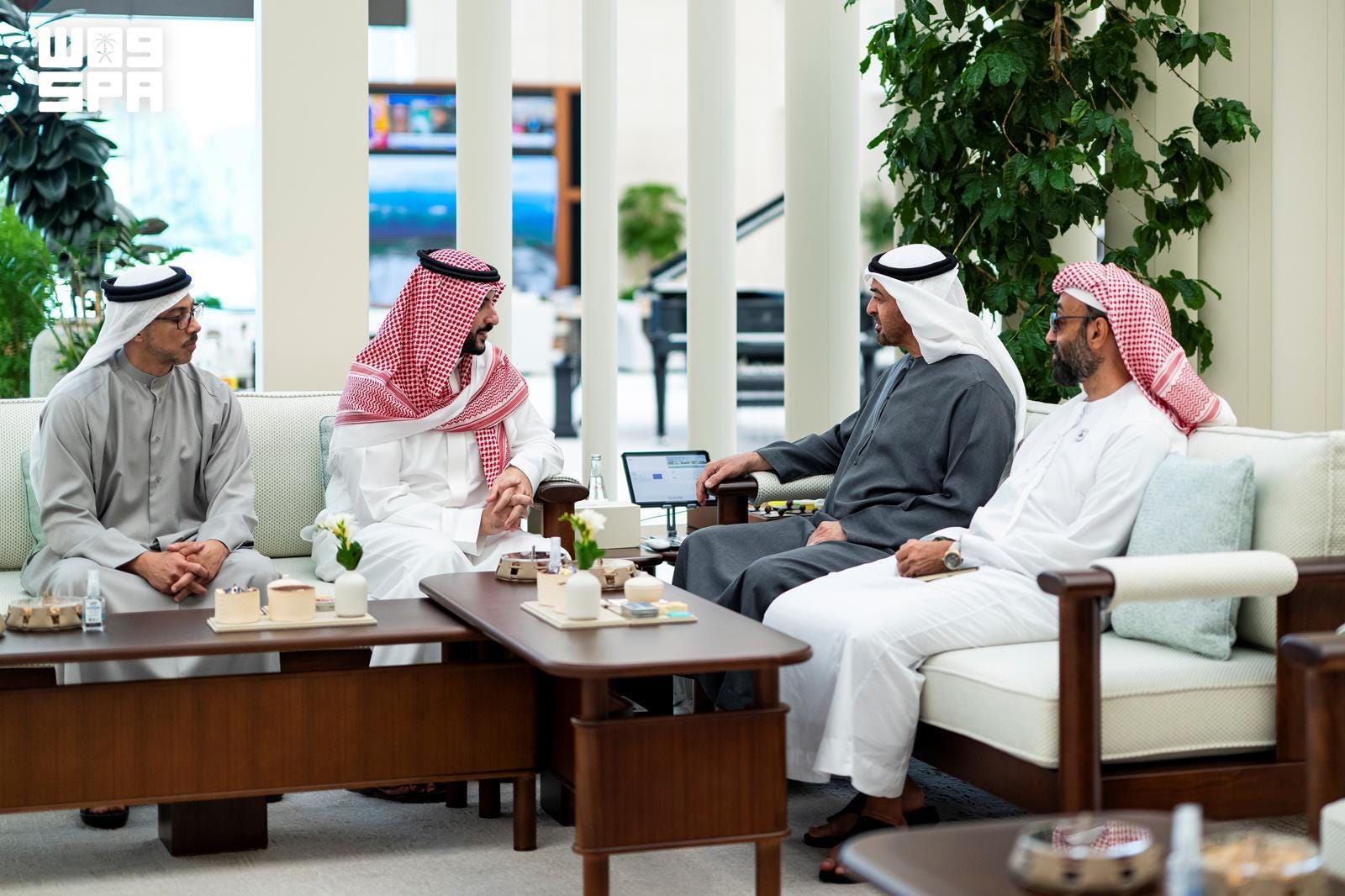
UAE President Sheikh Mohamed bin Zayed meets Saudi Defence Minister Prince Khalid bin Salman at Qasr Al Shatie in Abu Dhabi, 18 October 2026. Photo: Saudi Press Agency.
spa.gov
Morning. Steve Moore here. Saudi Defence Minister Prince Khalid bin Salman travelled to Abu Dhabi on Sunday, at the Saudi leadership’s direction, to meet with Sheikh Mohamed bin Zayed and discuss regional developments and priorities for the coming period.
The visit came as the UK Maritime Trade Operations Centre (UKMTO) reported that a tug was struck by two unknown projectiles northeast of Khor Fakkan, injuring one person. Meanwhile, Iran’s foreign minister said Tehran’s conditional proposal to reopen the Strait of Hormuz remained on the table.
For anyone planning to travel to Saudi Arabia, Etihad’s latest advisory extends its Riyadh and Dammam cancellations through Saturday 24 October. That is the practical place to start if you have a booking this week.
Subscribe to Emirates Wire for a weekday briefing on the developments that matter to people living and working in the UAE.
Abu Dhabi and Riyadh consult
Prince Khalid met the UAE president at Qasr Al Shatie, with Sheikh Mansour bin Zayed also present. WAM’s account names Sheikh Tahnoon bin Zayed, the UAE’s national security adviser, among those attending and says the discussions covered bilateral cooperation and regional security.
The Saudi account explicitly describes consultations on priorities for the coming period. Neither statement announces joint military action or a decision about American involvement. We should leave that distinction intact.
The fighting continued on Sunday: Saudi Civil Defence said a projectile hit a residential area in Najran, injuring six Saudi citizens and damaging three homes and three vehicles. Houthi media had reported at least 12 people killed in Saudi strikes in Yemen on Saturday, including three children; those figures were not independently verified in the reporting.
The minister’s visit deserves attention on its own terms. There is no need to turn a confirmed consultation into an unannounced military commitment.
Another vessel struck off the UAE
The tug was sailing southbound when it was hit northeast of Khor Fakkan, according to UKMTO’s report on Sunday. It sustained damage but continued its journey; the report did not identify the attacker.
UKMTO recorded 12 attacks in the week ending 16 October, ten in the Strait of Hormuz, one in the Gulf and one in the Gulf of Oman. Its weekly figures showed 125 outbound and 129 inbound transits, about 70% below pre-conflict levels.
US Central Command, which directs American military operations in the region, offered a different count: its commander said roughly 400 ships had passed through the strait over the previous week. The published accounts do not establish that the two counts use identical periods and coverage, so they should not be treated as a clean comparison.
Iran’s Revolutionary Guard also claimed that two tankers caught fire after hitting mines. That account remains unverified and should not be added to the confirmed incident tally.
Tehran repeats its conditional offer
Speaking in Baghdad on Sunday, Iranian Foreign Minister Abbas Araghchi said the proposal to reopen Hormuz was “still on the table”. Iran’s conditions include lifting the US blockade of its ports, removing sanctions on its oil exports and ending hostilities on all fronts.
Under Tehran’s proposed sequence, acceptance would reopen the strait within six days, followed by talks the next day. This remains a conditional offer, with no agreed countdown to reopening.
In a CBS town hall broadcast on Saturday, US Vice President JD Vance said Washington wanted a “final firm commitment from the Iranians that they’re not going to rebuild their nuclear program”. Reuters reports that Washington wants to address nuclear issues from the outset, while Tehran wants the first phase to focus on the strait and navigation security.
That disagreement over sequence matters for any assessment of the offer. A timetable written into one side’s proposal is a poor basis for making travel or shipping plans.
Check the flight, not the airport headline
Etihad says it has cancelled all its Abu Dhabi–Riyadh and Abu Dhabi–Dammam flights through 24 October. Its advisory also lists Jeddah services EY601, EY602, EY603 and EY604 as cancelled through that date.
Riyadh Air’s advisory lists its Riyadh–Dubai and Dubai–Riyadh flights, RX243 and RX244, as cancelled on Monday 19 October. Check the operating airline’s flight-status page using your flight number and travel date before leaving for the airport.
Reports about King Khalid International Airport’s reopening were inconsistent on Sunday. The National reported it had reopened, while The Daily Star said Saudi aviation authorities had not yet confirmed operations had resumed.
An airport reopening and an airline restoring your flight are separate decisions. A booking still visible in a search engine is not sufficient confirmation.
Abu Dhabi’s 2029 hosting agreement signed
Looking beyond the immediate disruption, the UAE signed the agreement to host the 2029 International Monetary Fund and World Bank Annual Meetings in Abu Dhabi. The signing took place in Bangkok on Sunday at the conclusion of this year’s meetings.
Minister of State for Financial Affairs Mohamed bin Hadi Al Hussaini and Central Bank Governor Khaled Mohamed Balama signed for the UAE, alongside World Bank President Ajay Banga and IMF Managing Director Kristalina Georgieva. It will be the UAE’s second time hosting the meetings, after Dubai in 2003.
What I am watching
I will look for any substantive announcement after the Abu Dhabi talks and a clear American response to Araghchi’s restated offer. For travellers, the useful update will be confirmation that individual services are operating.
If this edition helps someone plan in the Gulf this week, please share it. Thank you for reading, and send stories, tips or perspectives to steve@emirateswire.co.uk.
If your travel plans have changed again, I would be interested to hear what your airline has told you. I will keep the next briefing focused on confirmed changes.
Steve
Emirates Wire uses AI tools to assist with research, early drafting, fact-checking and copy-editing. Steve Moore reviews, edits and personally approves every sentence before publication.