The market says the UAE held. What held it?
Dubai’s stock market has recovered everything it lost since the conflict began in February. The recovery shows what the UAE did right over nine hard months.

Subscribe to Emirates Wire for weekday UAE briefings and a longer read on Saturday: https://www.emirateswire.co.uk/subscribe
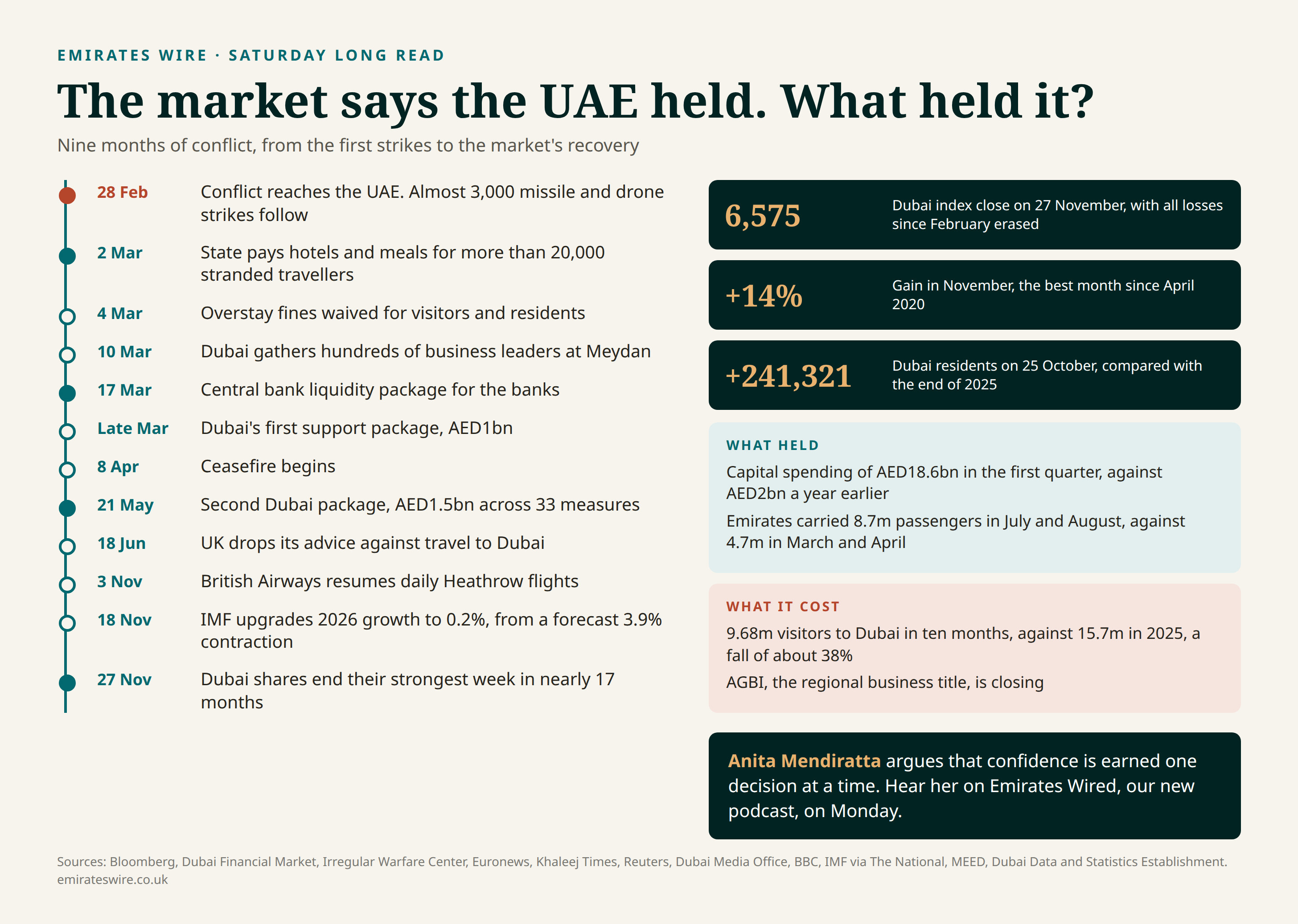
On Friday, the Dubai Financial Market General Index closed at 6,575.07. It ended its strongest week in nearly 17 months and now stands 8.7 per cent higher than at the start of the year. Dubai shares have recovered all the ground they lost after the conflict began, and that November’s gain of about 14 per cent is the market’s best month since April 2020. Among Gulf markets this year, only Oman has done better.
Markets are blunt instruments, and they can be wrong. But they put money behind a judgement, and this month’s judgement is clear. Investors think the UAE came through the worst of the conflict in better shape than they feared in March.
That makes this a good moment to ask what actually held. The answer matters to anyone who lives in the UAE, invests there or is thinking of moving. It is also less obvious than a rising index suggests.
Where it started
The conflict reached the UAE on 28 February. According to the Irregular Warfare Center, a US research body, the country has since faced almost 3,000 Iranian missile and drone strikes. Airspace was closed, and flights stopped. Visitors were stranded with no way home.
Anita Mendiratta, a special adviser to the Secretary-General of UN Tourism, joined us on Emirates Wired, our new podcast, on Monday, and spoke to France 24 within days. She said confidence in the Gulf as a destination and as a hub for air travel had been fundamentally broken. She warned that the damage would last, because a traveller has to feel safe in a place before choosing to go there. Travel and trade make up about a quarter of Dubai’s economy, by her estimate, so this was a direct threat to how the emirate earns its living.
In the same interview, she made a second point that has been well received. She called Dubai an excellent international example of crisis leadership. She said the airports, the airlines, and the tourism authority worked closely together in good times, which is why they could move quickly in bad ones.
The first fortnight
The early decisions bear her out. From 2 March, the UAE government paid for hotels and meals for more than 20,000 travellers stranded by the airspace closure, according to Euronews. Mendiratta said the government made it plain from the start that keeping travellers housed and safe came first, and that the state would absorb the cost. On 4 March, the authorities waived overstay fines for visitors and residents caught by the shutdown, Khaleej Times reported.
On 10 March, days after the first strikes, Dubai’s Department of Economy and Tourism gathered hundreds of business leaders at the Meydan hotel. Reuters later reported that Sheikh Hamdan bin Mohammed, the Crown Prince of Dubai, moved between the tables asking for ideas. Officials asked the room how to win back tourists and investors, and what business needed to get through. Five people who were there told Reuters the meeting helped bring about the measures that followed.
The first came from the UAE Central Bank a week later. On 17 March, it approved a package that let banks draw on reserve balances of up to 30 per cent of their cash reserve requirement, with term funding in dirhams and dollars. It also relaxed some capital and liquidity rules for a time. The board said the financial system had shown resilience with no material damage to the health of the banks or the payment systems, Reuters reported.
Spending through the storm
Dubai followed with direct help for businesses. An AED1bn package approved in late March let companies defer government fees. A second package of AED1.5bn, announced on 21 May, added 33 measures across tourism, retail, schools, culture and property, including waivers of the tourism dirham and hotel sales fees. The total reached AED 2.5 bn, according to the Dubai Media Office.
That is a modest sum. Reuters noted that the roughly $681m committed was less than the $1.93bn Dubai spent during the pandemic, and a small fraction of the emirate’s economy. The heavier lifting came from capital spending. MEED reported that consolidated capital spending across the UAE reached AED18.6bn in the first quarter of 2026, against AED2bn a year earlier. The country moved from a surplus to a deficit as it spent on projects and social benefits. Fitch, the ratings agency, said the authorities had brought forward tendering on several projects, partly to make infrastructure more resilient to future attacks and partly to restore confidence. It expects Abu Dhabi to raise government spending by about 19 per cent this year.
Kato Mukuru of Cantor Fitzgerald, who recommended UAE banks to clients in March, told Bloomberg that government spending made up for much of the foreign investment that fled. He also said residents had come back.
The people stayed
That last point is the one I find most striking. A city built on newcomers can empty quickly when the missiles start, and many expected Dubai to do so. It did not. The Dubai Data and Statistics Establishment counted 4,821,621 residents on 25 October, which is 241,321 more than at the end of 2025. Morgan Stanley told clients that Dubai’s October population was 2.4 per cent above its pre-conflict peak, with rental registrations and road traffic also rising.
Residents stayed partly because the state kept the basics running and partly because many had nowhere better to go. Either way, a city that keeps its people keeps its rents and its payrolls, and a stock market recovery stands on those.
Confidence as a currency
Mendiratta has returned to one idea through the year, and she will expand on it on Emirates Wired. Confidence, in her account, is something governments and businesses earn through their actions.
In June, when the US and Iran were preparing to sign a deal to end four months of fighting, she told Gulf News that aviation and tourism no longer answer a crisis with panic. They answer it with planning. She said the industry had learned from earlier recoveries that reliability creates trust, and that trust creates demand.
Later that month Britain’s Foreign Office dropped its advice against travel to Dubai. On Dubai Eye, Mendiratta explained why that mattered more than it might appear. Travel advisories affect insurance and package holidays, she said, and about half of Dubai’s leisure visitors arrive on packages. She called confidence one of the most important currencies a tourism economy can hold in a crisis.
In another interview with the station, she described confidence as the most precious fuel for aviation alongside jet fuel. She said that when the UAE speaks confidently about recovery, the rest of the aviation world listens, especially when the voice belongs to Sir Tim Clark, president of Emirates. She argued that Emirates was showing confidence through the flights it ran, and that other airlines drew confidence from that.
The numbers since then have followed her logic. Emirates carried 8.7 million passengers in July and August, against 4.7 million in March and April, according to The National. In October, Dubai welcomed 1.15 million international visitors, its highest monthly total since February. British Airways resumed daily flights from Heathrow on 3 November, after eight months away.
What it cost
The recovery is real, but it is incomplete. Dubai received 9.68 million international visitors in the first ten months of the year, compared with 15.7 million over the same period in 2025. That is a fall of about 38 per cent, and tourism is the part of the economy Morgan Stanley says is still lagging. The Foreign Office warned again on 18 November that the situation remains deeply unpredictable.
The cost shows up elsewhere too. This week Arabian Gulf Business Insight, the regional business title known as AGBI, announced that it will close. Its owners blamed the economic fallout of nine months of conflict. AGBI was a serious publication with good reporters, and its closure is a reminder that a recovering index can sit alongside businesses that did not make it.
The IMF captured both sides of the story this month. Its mission to the UAE found strong resilience, which it credited to large public and external buffers and a swift, targeted policy response. It now expects the economy to grow by 0.2 per cent this year, whereas it had forecast a 3.9 per cent contraction. A growth rate close to zero is still a hard year for a country used to rapid expansion.
The test ahead
The market has priced in a good deal of hope. JPMorgan has upgraded UAE shares to overweight, arguing that they are cheap and more resilient than investors thought. The MSCI UAE index trades at 9.4 times expected earnings, against a ten-year average above 10. The IMF expects growth of 7.3 per cent next year, provided the disruption lifts.
Two risks hang over that view. Bloomberg reported that President Trump may resume strikes next year if talks with Iran fail. And Mukuru warned that peace could slow the rally if governments pull back the support that carried the economy through the crisis. The spending that held the UAE together this year will be hard to keep up, and harder to withdraw.
So what held? Money mattered, and the UAE had plenty of it in reserve. But money alone does not keep 4.8 million people in a city under fire. What kept them was a state that housed stranded strangers in the first week and then kept spending when the bills came in. Mendiratta’s point is that confidence is built one decision at a time. This month the index caught up with nine months of those decisions.
Anita will say more on Emirates Wired this week. Do listen.
The market has made up its mind. The rest of the UAE is still making up the ground.
Emirates Wire uses AI tools to assist with research, early drafting, fact-checking and copy-editing. Steve Moore reviews, edits and personally approves every sentence before publication.
Discussion about this post