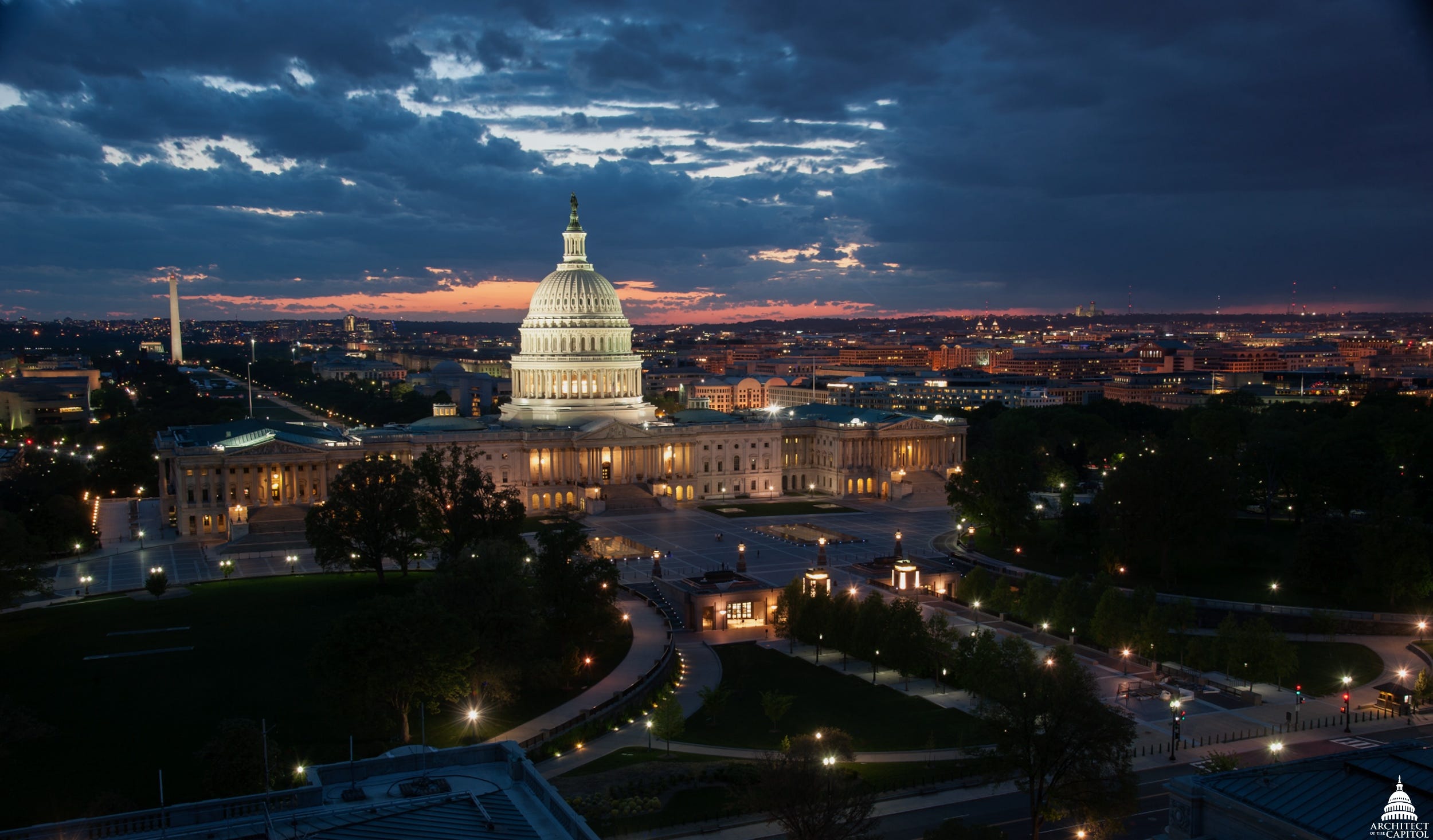
The night Washington changed hands
Democrats now hold Congress. They cannot end the Iran conflict on their own, but they can make escalation harder and Gulf deals slower

By Steve Moore
Emirates Wire is free. If someone forwarded this to you, subscribe for the Gulf briefing every weekday morning and the long read on Saturday.
Americans voted on Tuesday after eight months of conflict with Iran, with petrol nearly 50 per cent dearer than in February and diesel up by about two thirds. By breakfast in Abu Dhabi on Wednesday, they had handed both houses of Congress to the Democrats. For the first time in his second term, Donald Trump faces a legislature he does not control.
For the Gulf, the result changes less in the next two months than the headlines suggest, and more over the next two years than Washington’s Gulf partners may want.
The result
The Senate went first. The Associated Press (AP) called it after Iowa lawmaker Josh Turek beat Ashley Hinson for the seat Joni Ernst is vacating. By the early hours, Democrats had taken seven Republican seats: Iowa, Texas, Ohio, Kansas, North Carolina, South Carolina and Maine.
Several of those were not meant to be in play. In Texas, James Talarico beat Ken Paxton in what CNN called the most expensive Senate race in American history. Adam Hamilton, a megachurch pastor, became the first Democrat to win a Senate race in Kansas since 1932. In South Carolina, Annie Andrews, a paediatrician running for office for the first time, beat Darline Graham, sister of the late Lindsey Graham, for a seat Republicans had held since 1964. In Maine, Susan Collins conceded to Troy Jackson after nearly 30 years in the Senate. In Michigan, Abdul El-Sayed declared victory before dawn and would be the first Muslim senator.
By Wednesday morning, AP had Democrats on 54 seats and Republicans on 42, with four still to call. Alaska, which counts by ranked choice, may take weeks.
The House followed in the small hours. Democrats needed a net gain of three seats and passed the 218 needed for a majority before dawn on the East Coast. The final margin is still being counted, but NBC News projects around 255 Democratic seats, the party’s largest majority in nearly two decades. Hakeem Jeffries is in line to become the first Black Speaker of the House, subject to a floor vote in January.
In Texas, Gina Hinojosa also unseated Governor Greg Abbott. Only three times since the Second World War have both chambers changed hands in a single midterm: 1946, 1994 and 2006. Tuesday makes four.
Who sits where
For Gulf readers, the names matter more than the arithmetic, and several familiar ones survived. Jim Risch, the Idaho Republican who chairs the Senate Foreign Relations Committee, was re-elected. So were Tom Cotton of Arkansas, one of the Senate’s loudest hawks on Iran, and Jack Reed of Rhode Island, the senior Democrat on Armed Services. In January, Democrats took the chairmanships.
Collins’s defeat may matter most. She chairs Senate Appropriations, the committee that sets spending on defence and foreign aid. With her gone and the chamber in Democratic hands, Democrats will control the money, which is where Congress has real power over a conflict.
Foreign Relations is less settled. Jeanne Shaheen, its senior Democrat, retired this year, and Chris Pappas won her New Hampshire seat, so the chairmanship is open. Democrats are themselves divided over Israel. Some want to cut military aid; others want limits on particular weapons. A change in the majority does not, by itself, stop aid.
What Congress can and cannot do
Trump gave his verdict in a phone call with The Wall Street Journal on Tuesday night. “Iran was a piece of it,” he said, and then: “I don’t think about it. I did the right thing. I would have done it again.” He blamed petrol prices rather than the conflict, and the candidates rather than himself. He also told Democrats what to expect. They could send him “50 different great bills”, he said, and he would send them back stamped “veto”.
That veto is the first limit on Democratic power. Democrats can now pass a binding War Powers Resolution ordering the president to end hostilities with Iran unless Congress authorises them; the Republican Congress passed only a non-binding version in June. Trump would veto it, and Democrats lack the two-thirds of both chambers needed to override him.
Money is the stronger lever. A Congress that writes the budget can add “no funds may be used for” clauses to defence bills, barring spending on ground operations or a major escalation. Michael O’Hanlon of the Brookings Institution told Deutsche Welle that Congress could perhaps prevent a major escalation by refusing to pay for it. That lever has limits too. The naval blockade of Iran, which has kept around 20 American warships in the region for months, runs on existing authority and existing money. What Democrats could block is a large request for extra funding, or a wider campaign.
The second limit is the calendar. The new Congress sits on 3 January. Until then, the outgoing Republican majorities stay in place, and nothing decided on Tuesday restrains the administration in November or December. Gulf governments have spent weeks preparing for renewed strikes, and those eight weeks are when they would come.
The third factor is inside the White House. The Journal reports that some White House officials and Republican allies now call the conflict misguided, and say Tuesday would have gone very differently had it ended months ago. Trump is not budging. But his own advisers are now questioning a policy he will not change, and the Gulf did not face that a week ago.
What it means for Abu Dhabi
Emirati officials saw this coming. On the eve of the vote, a senior official in Abu Dhabi told the Atlantic Council: “We are bracing for the worst, but we are counting on a breakthrough. What we want is continued economic pressure to bring about a political outcome and not to go to war.” A Congress sceptical of the conflict leans the same way. The cost to the Gulf comes through scrutiny.
Analysts speaking to Arabian Gulf Business Insight (AGBI) before the vote called a Democratic win a mixed blessing: more pressure to end the conflict, and much closer scrutiny of arms sales and of business ties to the president’s circle. They named the UAE investment in World Liberty Financial, the Trump-backed cryptocurrency venture; the Trump Organization’s projects with Dar Global across the Gulf; and Qatar’s gift of a Boeing 747 for use as Air Force One. Kristian Coates Ulrichsen, a long-time Gulf analyst, argued that hundreds of billions of dollars in pledged investment “haven’t brought the security that leaders in the Gulf had hoped for”, because Trump did not take Gulf interests into account when he went to war with Iran.
The technology deals carry the most risk. The administration has given G42, Abu Dhabi’s AI champion, and its cloud arm Core42 access to the most advanced American chips without an export licence, and approved up to 35,000 for Humain in Saudi Arabia. As the business newsletter Enterprise reported last week, Democrats cannot undo deals already made. But the terms run out. G42 and Core42 must become US companies by 6 April 2027, or seek fresh approval to keep licence-free access, and that renewal will happen with a Democratic Congress watching.
Oil markets have not yet decided what the result means. Brent rose to about $104 a barrel on Wednesday morning, Reuters reported, reversing earlier falls as traders waited for Washington’s next move. Sultan Al Jaber, chief executive of the Abu Dhabi National Oil Company (ADNOC), says the world has drawn down almost a billion barrels of stocks since shipping through the Strait of Hormuz was disrupted.
Normalisation with Israel also looks harder. Amir Tibon, the Haaretz journalist, wrote overnight that it is hard to imagine this Congress approving a large package for Saudi Arabia in return for a deal with Israel, “at least not while Netanyahu is prime minister”. Israel’s own election has ended in deadlock, and Yair Lapid, the opposition leader, says the American result rules out a unity government led by Netanyahu. The UAE was among the first to sign the Abraham Accords. The next step in that framework, a Saudi deal, now depends as much on coalition talks in Jerusalem as on anything in Washington.
Two readings of the same night
Some see an opening for diplomacy. Esfandyar Batmanghelidj, founder of the Bourse & Bazaar Foundation, wrote on Wednesday that the result “might set the stage for a deal to end the Iran war, both in Washington and Tehran”. In his view, a weakened administration will meet more internal resistance to escalation, while Iran’s leaders can claim a political victory that makes concessions easier to sell at home.
Tehran is already claiming it. Mohammad Bagher Ghalibaf, the speaker of Iran’s parliament, wrote that Americans “said NO TO WAR, and we endorse this message”, and warned that if Washington ignored its voters, “our NO comes with a Nightmare”.
Others read the result differently. Before the vote, a US official told Axios that heavy Republican losses could make a large military operation more likely; the White House denied it. On Tuesday, a senior Iranian official told Reuters the two sides were “still far” from a deal. And a president who says he would do it all again does not sound like a man looking for the exit.
The conflict from here
Qatar has spent the past week trying to head off renewed fighting. After long rounds of talks in Tehran and Doha, its foreign ministry says both sides are reviewing its proposals. Under the plan as reported, the United States would lift its blockade of Iranian ports and waive sanctions on Iranian oil sales, and Iran would reopen the Strait of Hormuz, before talks on everything else.
At the same time, the AP reports, American officials have told several governments in the region to prepare for possible renewed action against Iran, and for Iranian retaliation. On Monday, the eve of the vote, US forces carried out what officials called limited, defensive strikes on Iran’s Qeshm Island. Trump says there are no immediate plans for more, but that the military is “locked and loaded”. Iran has threatened to hit oil and gas facilities in Saudi Arabia, the UAE, Qatar, Kuwait and Bahrain if its own energy infrastructure is struck.
The fighting has also spread well beyond Iran. In Yemen, the Houthis have advanced to within 80km of Aden and fought for ground near the Bab al-Mandeb strait, while trading strikes with the Saudi-led coalition; the group says it has hit Dammam airport. In southern Lebanon, Israeli demolitions continue. Washington’s new majorities have little reach over any of these fronts.
What to watch
The first test is the next eight weeks. Any decision on renewed strikes would come before the new Congress sits.
The second is Doha. If Qatar’s plan leads to direct talks between Washington and Tehran, Iran’s claim of political victory may make concessions easier to sell. If it stalls, the run-up to January becomes more dangerous.
The third is the first round of hearings. Democrats have promised to examine the cost and conduct of the conflict, and Gulf investments linked to the president’s circle are likely to come under the same light.
The fourth is April 2027, when the G42 chip arrangement comes up for renewal and a Democratic Congress gets its first clear opening on the Gulf’s AI ambitions.
Americans voted largely on petrol prices. The Gulf, which pumps much of the world’s oil and sits within range of Iran’s missiles, has more riding on what Washington does next than most of the people who voted.
How this piece was made: Steve Moore reported, wrote and edited this piece. AI tools helped gather research and produce early drafts, under close editorial control, and every claim was checked against the original reporting. Results were last checked at 08:45 UK time on Wednesday 4 November; several races are still being counted.
Know someone who follows the Gulf? Forward this to them, or share it on LinkedIn.
Thank you for reading Emirates Wire. Stories, tips and perspectives are always welcome at steve@emirateswire.co.uk.
Steve, fantastic analysis on how the power shift in Washington will play out in Abu Dhabi and across the region. You captured the nuance exceptionally well—especially how the immediate post-election window remains the most unpredictable period, even if long-term constraints around funding and tech deal renewals will eventually set in. The breakdown of how congressional control intersects with the G42 chip licenses and broader regional security was particularly insightful. Excellent piece as always!