The UAE’s AI bet meets its first real test.
OpenAI signed four deals in Abu Dhabi on Monday. On Thursday the Nasdaq had its worst day in 19 months. The UAE is now host and banker to the AI industry, and this week showed what that exposes.

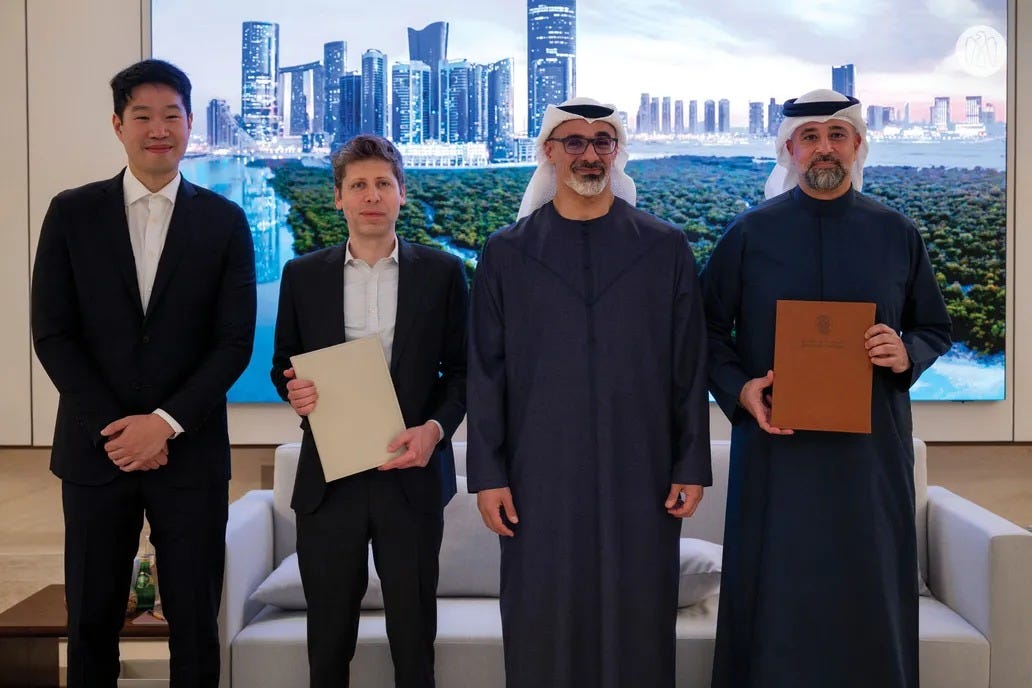
Photo: Abu Dhabi Media Office
On Monday, during a visit by Sam Altman, OpenAI signed four agreements in Abu Dhabi with the emirate’s oil company, its government, and its sovereign wealth fund. On Thursday, the Nasdaq had its worst day in 19 months, as investors took fright at the cost of the AI boom. The UAE has gone further into AI than anyone in the region, and this week showed how exposed it is.
The week began in a conference hall built for oil. At ADIPEC, the energy exhibition that fills Abu Dhabi every November, the guest who drew crowds on Monday was OpenAI’s chief executive. Sam Altman met Sheikh Khaled bin Mohamed, the Crown Prince of Abu Dhabi, who then watched OpenAI sign four agreements with Emirati institutions. On stage afterwards, Gulf News reported, Altman called the UAE the world’s most forward-looking country for AI adoption.
Three days later, the mood in New York was very different. The Nasdaq fell 5.5 per cent on Thursday, its sharpest drop since April 2025, and closed in correction territory, more than 10 per cent below its October peak. Reuters reported that investors were reacting to the Democrats’ sweep in Tuesday’s midterm elections and to fears that a new Congress would slow data centre construction. Nvidia lost about 9 per cent in a day.
The two events are linked. Much of the UAE’s bet on AI rests on the American companies whose shares fell this week.
What Abu Dhabi signed
The broadest agreement is with ADNOC, the state oil company. Working with OpenAI and Inception42, part of the Abu Dhabi AI group G42, ADNOC will become the first energy company to use OpenAI’s most advanced models across its operations. The Abu Dhabi Media Office said the models will run on computers inside the UAE. ADNOC will use them to draft oilfield development plans and model how production choices feed through to refining and trading.
The second agreement is with the Abu Dhabi government, which with OpenAI, has launched what it calls the world’s first machine-readable government. The Department of Government Enablement, which leads the project, is converting policies and regulations into a form AI systems can read, so software can help officials check permit and certificate applications against the rules. The first pilot is already checking food imports at the Abu Dhabi Agriculture and Food Safety Authority, and officials keep the final decision.
The other two agreements bring OpenAI’s models into Mubadala, the sovereign investor, for investment analysis and risk assessment, and give Inception42 a five-year partnership to spread them across government, business, and education. None of the four came with a price. Ashish Koshy, Inception42’s chief executive, told Arabian Gulf Business Insight (AGBI) that the commercial values would not be disclosed.
The deals capped a busy fortnight for AI in the Emirates. At the Dubai AI Festival the week before, Sheikh Hamdan bin Mohammed, the Crown Prince of Dubai, set a target for the Dubai AI Campus of more than 1,000 companies and 5,000 jobs by 2030. During the same week, Scale AI, the American company that prepares training data for AI models, opened in the Dubai International Financial Centre.
Customer, host and banker
The UAE now plays three parts in the industry. It is a customer of the American AI companies, through ADNOC and the Abu Dhabi government. It is also building the infrastructure they run on. The two governments announced the UAE-US AI Campus in Abu Dhabi during President Trump’s visit in May 2025, with a planned capacity of 5 gigawatts. G42 is building its first phase, a 1-gigawatt cluster known as Stargate UAE, with OpenAI and Oracle as operators and Nvidia as a partner. The first 200 megawatts are due this year.
The UAE is increasingly paying the bills. MGX, the Abu Dhabi investor founded by Mubadala and G42, closed a $49 billion AI fund in July. MGX holds stakes in OpenAI, Anthropic and xAI, and co-led OpenAI’s $122 billion funding round in March. According to the Financial Times, OpenAI has now cut the target for a further round from $30 billion to about $20 billion, at a valuation of around $1.25 trillion, down from the $1.4 trillion discussed earlier in October. The FT reported that a consortium of UAE investors, including MGX, is expected to be the largest backer. As part of the deal, Forbes reported, OpenAI would get an option to lease new computing capacity in the Gulf.
Altman’s visit was also a fundraising trip. The deals signed on Monday made the UAE a bigger customer of a company whose own funds are being asked to prop up at a lower price.
The bill comes due
The Nasdaq had been slipping before Thursday, after disappointing results from Alphabet, Amazon, and Intel, as investors began to ask when the hundreds of billions being spent on data centres would turn into profit. The election added a political fear to the financial one. In the US, local opposition to data centres has grown over their use of power and water, and UBS estimates that about 30 per cent of the data centre capacity the US expects to add in 2028 is at risk of construction pauses.
The Gulf’s exposure is large. The International Monetary Fund estimates that Qatar, Saudi Arabia and the UAE announced plans in 2025 to invest about $120 billion in AI. Global SWF, which tracks sovereign funds, puts Mubadala’s identifiable AI exposure at $24.3 billion, or 6.3 per cent of its assets, the business newsletter EnterpriseAM reported. For Saudi Arabia’s Public Investment Fund (PIF) the figure is 1.3 per cent.
AGBI asked analysts this week what a downturn would mean. Vijay Valecha, chief investment officer at Century Financial, argued that the Gulf would feel an AI bust through its overseas portfolios, through data centres at home that might never be built and through the price of oil, if an American slowdown cut demand. Héla Miniaoui, an associate professor at Lusail University in Qatar, warned that large funds can absorb a loss but would then have less to spend elsewhere.
Some of the caution is now local. BlueFive Capital, an Abu Dhabi investment firm, told AGBI it is reining in its AI investments and expects most of the world’s AI start-ups to fail. The evidence on demand is also mixed. A study by Amazon Web Services (AWS), the UAE AI Office and Strand Partners found that 72 per cent of UAE businesses use AI. But just under a third of those use it at a “transformative” level, with custom systems and advanced workflows, and 47 per cent stick to basic tasks such as chatbots.
Abu Dhabi’s answer is patience. Koshy told AGBI that he saw no bubble about to burst. He accepted that valuations may need recalibration, and said Inception42 builds customers’ projects alongside the data centres rather than building first and looking for customers later. Daniel Brett of Global SWF, speaking to EnterpriseAM, put the risks elsewhere. In his view, the bigger dangers for the Gulf are project delays and tighter access to chips.
The Washington problem
Chips are where Tuesday’s election may matter most to Abu Dhabi. In July, the US Commerce Department moved the UAE into Country Group A:5, its group of close partners, and let G42 and its cloud arm, Core42, buy the most advanced American chips without a licence. Forbes noted that the approval runs only until April 2027 unless it is extended. From January, EnterpriseAM pointed out, Democratic-led committees in Congress will be able to investigate the agreements behind Gulf access to American chips.
The technology publication Rest of World reported this week that the UAE and Saudi Arabia both still rely heavily on Nvidia. The first stage of Stargate UAE is designed around 400,000 Nvidia chips. The UAE has already paid for that access: G42 divested from its Chinese partners under American pressure before Washington cleared the chip sales.
The conflict and the campus
The conflict with Iran has given the AI campus a risk tech investors seldom price in. In March, two AWS data centres in the UAE were damaged in Iranian attacks. In April, a video issued by Iran’s armed forces named Stargate UAE as a potential target. Reuters reported in September that the 5-gigawatt campus is likely to become a network of sites across the country, some built underground and protected by air defences. G42 said the work was progressing as planned and that aspects of the project remained under review.
At ADIPEC, Sultan Al Jaber, ADNOC’s chief executive, told delegates that data centres’ power use could rise fourfold by 2040. A survey commissioned by the exhibition from Kekst CNC found that 81 per cent of energy executives expect AI’s electricity demand to exceed current forecasts. In meeting that demand, Abu Dhabi has one advantage over Virginia and Texas, the biggest American data centre markets. Its power system is centrally planned, and the four reactors at the Barakah nuclear plant can supply up to a quarter of the UAE’s electricity. American data centres can wait years for a grid connection. In the Emirates, the state decides.
But the conflict has shown that the plant sits within drone range. In May, Forbes reported, a drone struck a generator outside the inner perimeter at Barakah. Nobody was hurt.
Riyadh runs a different race
The UAE has tied itself to American partners through the Abu Dhabi campus and MGX’s stakes in the leading labs. Microsoft, Amazon and Oracle have pledged about $40 billion to AI in the Gulf between them, EnterpriseAM reported. Saudi Arabia has focused on Humain, a PIF-owned company building capacity at home and planning about 6 gigawatts by 2034. In EnterpriseAM’s analysis last month, the UAE moves in step with Washington, while Riyadh concentrates on capacity inside its own borders.
The UAE is betting on speed. It moved first and already has data centres running, which also means it carries more of the risk if the market turns, because more of its money is already in the ground and in American valuations.
Britain played no part in this week’s deals, but it has its own AI agenda with the UAE. The framework for enhanced cooperation that the two governments agreed on in April names artificial intelligence among its priorities, alongside defence, trade, and the energy transition. When Andy Burnham spoke to Sheikh Mohamed bin Zayed, the UAE President, in July, the two leaders discussed working more closely on technology and AI. The trade agreement between the UK and the Gulf Cooperation Council (GCC), concluded in May, commits both sides to cross-border data flows, which matters for any British company hoping to serve Gulf clients from British servers.
Britain played no part in this week’s deals, but it has its own AI agenda with the UAE. The Framework for enhanced cooperation that the two governments agreed in April names artificial intelligence among its priorities, alongside defence, trade and the energy transition. When Andy Burnham spoke to Sheikh Mohamed bin Zayed, the UAE President, in July, the two leaders discussed working more closely on technology and AI. The trade agreement between the UK and the Gulf Cooperation Council (GCC), concluded in May, commits both sides to cross-border data flows, which matters for any British company hoping to serve Gulf clients from British servers.
The UAE wants more, and so do some British voices. The UAE’s ambassador in London, Mansoor Abulhoul, has argued for a UK-UAE comprehensive economic partnership agreement covering AI, data, and digital services. Lord Davies of Abersoch, the UK co-chair of the UAE-UK Business Council, has reportedly called for that agreement to centre on AI and data. For British firms, the opening lies less in chips than in the services around them, such as law, consultancy, and training.
What to watch
Anthropic, in which MGX holds a stake, is expected to list on the stock market this month, and its share price will show how public investors value a leading AI developer. Nvidia reports its quarterly results on Tuesday 17 November, and the market will read them as a verdict on the whole data centre boom. The first 200 megawatts of Stargate UAE are due before the end of the year, and G42 has not yet announced a date for switching them on.
The UAE’s long-term case is intact. It has the capital and the power, and its sovereign funds can wait out a correction that would break a smaller investor. The question has moved on. For years the test was whether the UAE could persuade the world’s AI companies to come. Now they have come, and the test is whether the business pays.
Altman told ADIPEC that energy is one of AI’s hardest problems. Abu Dhabi has sold energy for more than sixty years, and now it has to learn whether buying intelligence is as good a business.
How this is made
Emirates Wire is reported, written and edited by Steve Moore. AI tools help with research aggregation and early drafting. I check every fact against primary sources, and I read and approve every sentence before it goes out. I don't publish anything I haven’t personally stood behind.
Questions are welcome at any time at steve@emirateswire.co.uk.
Discussion about this post